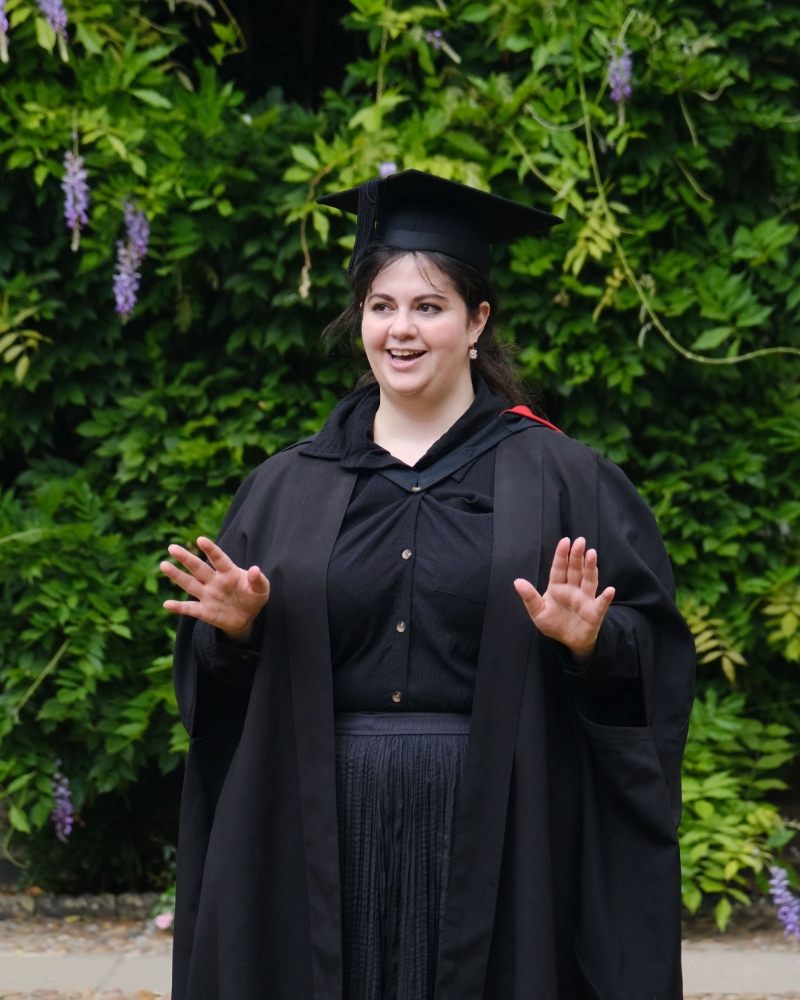
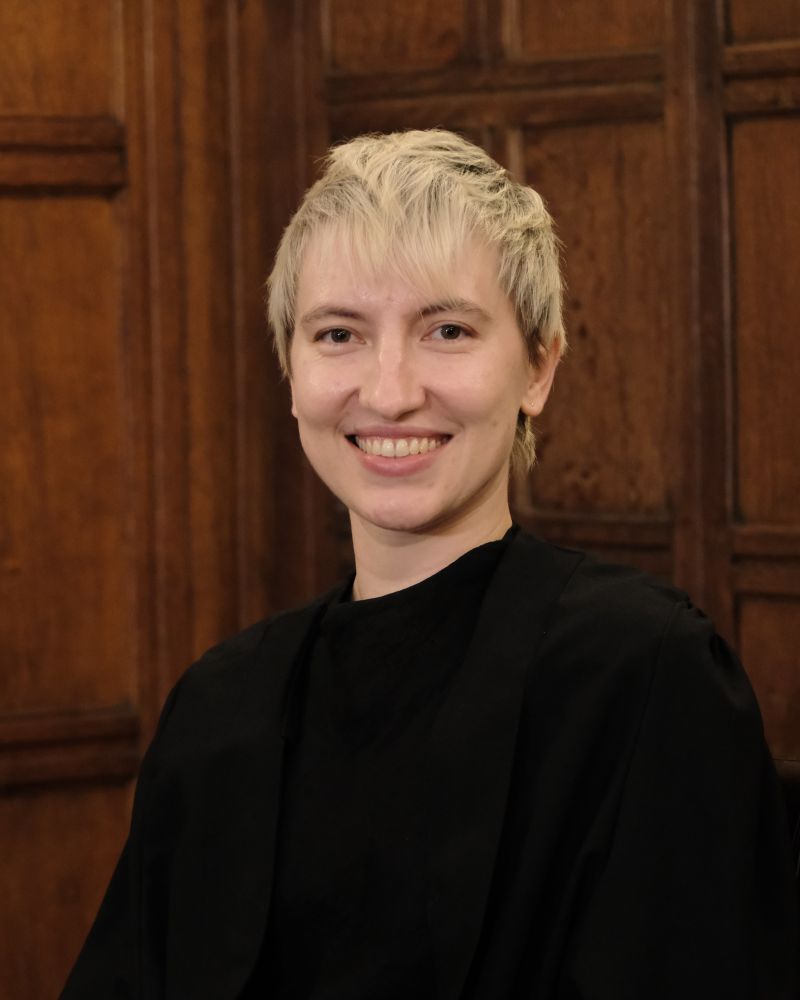
We’re delighted to welcome Professor Valeriya Malysheva back to College as Bye-Fellow in Computational Biology, four years after her time here as a post-doctoral research associate. A biophysicist by training, Valeriya now leads a Computational Neurobiology lab exploring how brain cells make decisions, both healthy and harmful, through an interdisciplinary lens. We caught up with her to hear about her research journey and what it means to return to Trinity Hall.
Five minutes with a Fellow
Posted:
06 May 2026
A photograph of two people standing beside a whiteboard in a classroom or workshop setting. One person is writing on the whiteboard with a marker while the other stands nearby, looking on. Notes and diagrams are visible on the board.
What first drew you to studying how brain cells make both normal and abnormal decisions, and why is this work so important right now?
I’ve always been interested in how complicated behaviour can come from simple parts working together. During my biophysics and maths training, that meant looking at systems where a few basic rules create surprisingly complex patterns. When I moved into molecular and cellular biology, I realised the same perspective can be applied to the brain.
At its core, the brain is made of individual cells that make decisions in response to external and internal stimuli: whether to divide, differentiate, activate or remain inactive. In healthy systems, these processes are remarkably well coordinated, but in disease, they can get out of sync. Understanding why this happens, even in a simple way, and figuring out how we might fix it felt like an important challenge to advance our knowledge of neurodegenerative diseases such as Alzheimer’s, Parkinson’s and motor neuron diseases.
You come from a biophysics background and now work across computation, systems biology and neuroscience – how do all those pieces come together in your lab?
In practice, these areas feel less separate than they might appear. Biophysics shapes how we think about quantitative reasoning and the identification of underlying structure. Systems biology emphasises that cellular processes and mechanisms are inherently interconnected, while neuroscience provides the biological context that motivates many of our questions.
In our lab, computational and mathematical approaches bring these perspectives together. We develop models and data-driven approaches to better understand how regulatory processes operate within brain cells. This often involves generating and working with large, high-dimensional datasets and collaborating closely with experimental groups. Our aim here is to uncover the key regulatory mechanisms underlying neurodegenerative diseases and to pinpoint the causal events that trigger them, as well as identifying potential drug targets and early warning biomarkers.
What is a big question your lab is excited about exploring at the moment?
We’re especially interested in how a cell’s identity in the adult brain is established, maintained and sometimes disrupted in disease, with a focus on genomic variability between cells within the same type. Many brain cells can remain stable for decades, but this stability can break down, and we may begin to see the early stages of neurodegenerative diseases. More broadly, we want to go beyond describing how cellular identity changes to understanding the mechanisms that drive these changes, using causally-grounded mathematical and machine learning approaches.
You were once a postdoctoral research associate here – what does it mean to you to return to the College community in this new role?
Returning to Trinity Hall as a Fellow is truly incredible. As a PDRA, I benefited greatly from the College environment not only through academic exchange but also through the broader sense of community, taking part in its vibrant cultural life, music and sports. Coming back now brings a sense of continuity and feels like coming home. It is a privilege to be part of such a fantastic community where conversations extend across disciplines and career stages. I look forward to contributing, giving back, and supporting students and early career researchers as they develop their paths.
One of the strengths of the collegiate system is the chance for frequent informal exchange across fields, and joining Trinity Hall gave a real boost to such links. I am especially excited about new collaborations with Fellows in neuroscience, machine learning and art. Teaching and supervising students is another extremely rewarding and exciting aspect. I truly enjoy teaching and learn a lot from the students. I am also excited to help students who may be considering paths that cross traditional disciplinary boundaries. Having moved between fields and connected academia with industry, I know it helps to see such transitions are possible.
Looking ahead, what do you think is the most exciting direction for computational neurobiology and how is your lab getting ready for it?
There is a great deal of momentum in combining different types of biological data across individual cells, tissues, organs and organisms. Integrating these layers in a meaningful way remains a significant challenge, but also presents a very promising direction. I expect that progress will also come from combining data-driven methods with mechanistic frameworks that are causally grounded. In particular, developing and applying causal theory and causal machine learning approaches will play a major role in advancing many areas of biology, not just neuroscience. So, as a group, we are developing methods that are flexible and powerful enough to work with complex multimodal datasets without compromising robustness or interpretability. It is an evolving field, which is part of what makes it so engaging to work in.
If we can understand more about how biological layers are connected, we can understand more about how changes at the cellular level will impact the organism as a whole. Ultimately, this could lead to earlier identification of disease and advanced personalised treatments.
Feature image of Professor Valeriya Malysheva during a biohackathon, taken by Teun De Voeght.