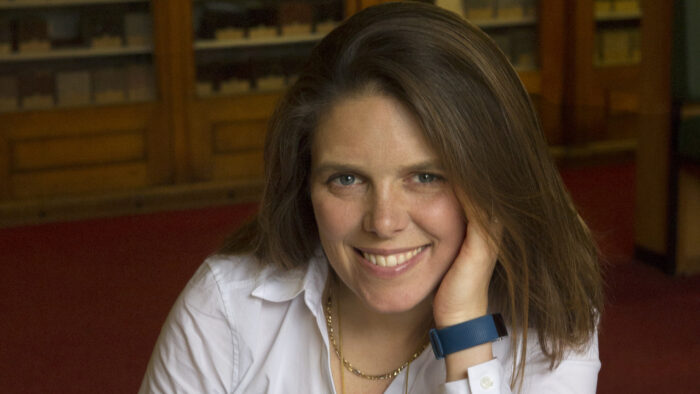
Professor Turchyn said: “The premise is that, if atmospheric CO2 increases then temperatures and rainfall will also rise – driving more continental silicate weathering, removing more carbon and in turn bringing temperatures down,” explained Turchyn. “However, decades of research have shown that the rates of continental silicate weathering depend only weakly on temperature and, indeed, the overall controls remain enigmatic.”
A new funding boost from the European Research Council (ERC) Advanced Grants scheme, which allows senior researchers to pursue ambitious projects, will aid Professor Turchyn’s work.
Professor Turchyn’s new project investigates another frequently underappreciated player in the global thermostat: the breakdown of seafloor basalt. When seawater circulates through basaltic crust at mid‑ocean ridges and ridge flanks it dissolves the silicate minerals, consuming CO2 and precipitating it as carbonate minerals.
She and a team will run a series of lab experiments that mimic submarine basalt weathering, upscaling these observations using computer models to understand the relative role of this process in the global carbon cycle.
“Understanding how submarine basalt weathering interacts with Earth’s climate system over a range of temperature and chemical conditions could transform our understanding of one of the most fundamental questions – how our planet achieved a stable climate and thus became habitable,” said Professor Turchyn.