Hidden Antarctic ice fractures may be driving rising sea levels
Posted:
17 Apr 2026
Person practicing crevasse rescue on a snowy glacier, secured by ropes, with another climber and ice-filled sea in the background.
Giant Antarctic meltwater pools may be forcing vast slabs of ice to crack apart and plunge into the ocean, speeding up sea level rise, say scientists. Now, for the first time, an army of sensors will be deployed across two ice shelves on the frozen continent to directly measure how this cracking happens.
Project leader Dr Rebecca Dell and her team will investigate the stability of Antarctica’s giant ice shelves, where the sheer weight of meltwater pools puts pressure on weak areas in the ice, causing it to break off into the sea. These ice shelves, floating extensions of the continent’s enormous glaciers, act as vital barriers, slowing the flow of land ice into the ocean. When they weaken or collapse, that protective buffer is lost, causing glaciers to move towards the sea more quickly and global sea levels to rise faster.
The process that breaks apart Antarctica’s ice shelves is known as hydrofracture. Yet hydrofracture has never been directly observed in the field, leaving a major gap in scientific understanding. Thanks to new funding from the Natural Environment Research Council, Dr Dell and her team, including Professor Ian Willis (University of Cambridge) and Dr Oliver Marsh and Dr Hamish Pritchard (British Antarctic Survey), can now begin to close this gap to improve our ability to monitor and ultimately mitigate future sea‑level rise.
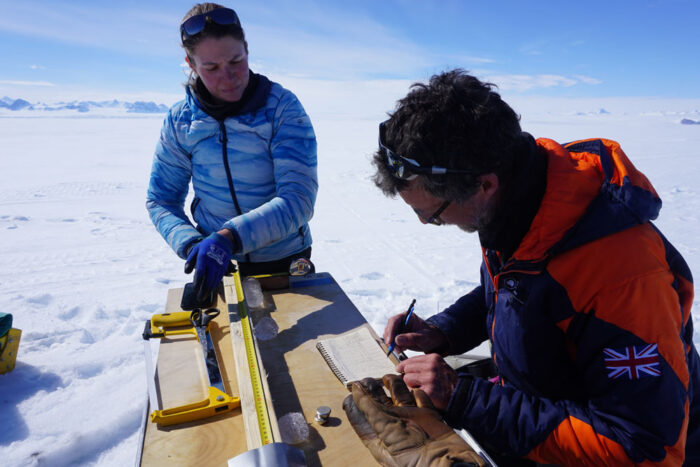
Dr Rebecca Dell and Professor Ian Willis taking shallow ice cores on George VI Ice Shelf. Photo by Mark Chambers.
For the first time, the team will directly measure water pressures, fracture mechanics and the physical processes that drive hydrofracture events across two contrasting ice shelves. They will deploy an array of sensors, timelapse cameras, GPS stations and seismic instruments across each ice shelf to capture the bending and stretching of the ice, known as meltwater loading, and the precise timing and location of crack formation. Together, the data will offer breakthrough insights to strengthen global predictions of future sea level change.
“We will finally be able to observe hydrofracture as it happens,” says Dr Rebecca Dell, Trinity Hall Fellow and Assistant Professor at the Scott Polar Research Institute at the University of Cambridge. “Field observations of this process are extremely limited, and none have yet gained the water pressure measurements needed to understand how much meltwater is required to damage or destabilise an ice shelf. This project will change that.”
In addition to field measurements, the team will combine satellite data and AI tools to scale their findings to other ice shelves around Antarctica. These broader observations will feed into KRAKEN, a viscoelastic ice flow model developed at the British Antarctic Survey, which will be upgraded to simulate hydrofracture across the entire continent.
Two postdoctoral researchers will play a central role in the team. Daniel Richards is already on board and will develop and calibrate KRAKEN using the new datasets. A second researcher, based at the Scott Polar Research Institute, will support fieldwork and year-round satellite monitoring of the study sites.
Climate change is rapidly increasing meltwater production across Antarctica, especially on the Antarctic Peninsula. Understanding how this meltwater influences ice-shelf stability is now urgent, as destabilisation could significantly accelerate global sea‑level rise. 10% of the world’s population lives within 5km of the coast, and around 30% are considered to live in coastal regions according to research from Cosby et al., 2024.
“This project gives us the data we need to project where and when ice shelves may become unstable in the future,” Dr Dell explains.
If successful, this will be the first-ever field project to directly observe cracks forming under hydrofracture conditions. Its findings will also shed light on wider consequences of ice-shelf collapse, including changes to ocean circulation, heat exchange and Antarctic marine ecosystems.
Dr Dell adds: “I’m excited about every aspect of this project! It’s my first time leading a major research grant, which is a challenge I’m ready to take on. I’m of course eager to return to Antarctica too, but ultimately, I’m excited to see how much we can progress our scientific knowledge when we combine the team’s expertise.”
About Dr Rebecca Dell
Dr Rebecca Dell is a remote sensing and fieldwork-based glaciologist at the Scott Polar Research Institute. She is an Assistant Professor in the University of Cambridge’s Department of Geography, and Staff Fellow and Director of Studies in Geography at Trinity Hall. She works closely with other academics and students to study Polar Regions, focussing on better understanding the stability of Antarctica’s ice shelves.
Dr Dell’s research currently employs a ‘Big Data’ approach to investigate Antarctic ice-shelf stability in relation to surface and shallow sub-surface meltwater through remote sensing and machine learning methodologies.
She has conducted two Antarctic fieldwork seasons for a NSFGEO-NERC funded project titled ‘Ice-Shelf Instability Caused by Active Surface Meltwater Production, Movement, Ponding and Hydrofracture’.
About the funding
The ‘Pushing the Frontiers Grant’ from NERC/UKRI will fund three Antarctic field seasons, two postdoctoral researchers, and associated project costs. It will be led by Principal Investigator, Dr Rebecca Dell.
The project is titled:
HYDRO-RIFT: Observing and modelling hydrofracture across the Antarctic Peninsula