Trinity Hall expertise help shape Cambridge’s New Whittle Laboratory
Posted:
22 Jul 2026
Professor Graham Pullan and King Charles talk in front of a large jet engine at the New Whittle Laboratory opening. Photo by Ian Jones.
Members of the Trinity Hall community have contributed to one of the UK’s most ambitious new engineering initiatives. The New Whittle Laboratory, a £58 million facility officially opened by His Majesty The King, will accelerate innovation in aerospace, energy and power generation.
Based on the University’s West Cambridge site, the facility has been developed to advance research in jet engines and power generation, and to help shorten the time it takes to develop key technologies in aerospace, energy and defence from years to weeks. It was officially opened on 20 July 2026, alongside the Frank Whittle Summit, which brought together researchers, industry leaders, technology companies and government representatives.
The College’s involvement spans leadership, innovation, research and event delivery. Professor Graham Pullan, alumnus and Fellow of Trinity Hall and Co-Director of the Whittle Laboratory, has helped develop the new facility; alumnus Dr Elliott Grant co-leads the Bennett Innovation Lab; alumnus Dr Nathan Clark has been involved in the Lab’s early projects; and alumna Dr Julia Massabuau worked on the official opening event.
Dr Massabuau (Materials Science, 2011), Technical Operations Lead for the Aviation Impact Accelerator, was heavily involved in organising the official opening event, helping to deliver a major public moment for the New Whittle Laboratory.
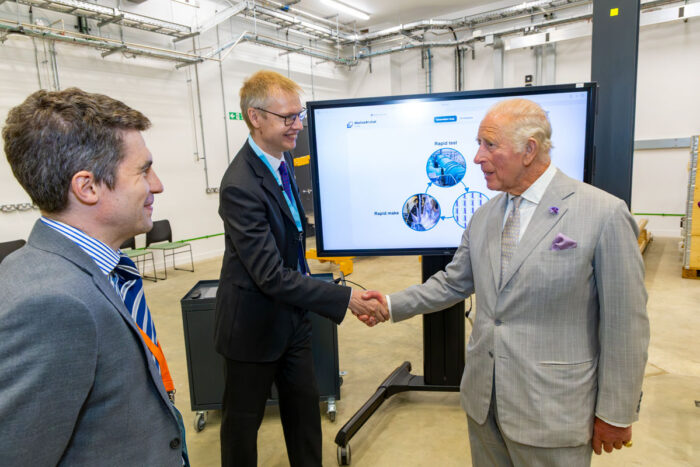
Professor Graham Pullan with His Majesty The King at the New Whittle Laboratory opening. Photo by Ian Jones.
Professor Pullan (Engineering, 1993) has been part of the Whittle Laboratory since 1997 and has served as Co-Director since 2020. Working with Professor Rob Miller and Nick Atkins, he has been involved with the architects and design team since the start of the project in 2018.
“The new experimental facilities allow us to do more tests, more quickly at more realistic conditions,” Professor Pullan said. “This enables us to accelerate our research and to expand the range of problems we can work on.”
His own research includes AI systems that help engineers make better use of data from experiments and computational simulations. Over the coming decade, he expects the Laboratory’s work to support advances in more efficient flight, as well as energy-related challenges including storage and the electrification of industrial processes.
The New Whittle Laboratory brings together two major initiatives: the National Centre for Propulsion and Power, a rapid test facility, and the Bennett Innovation Lab, which is designed to launch 20 to 30 missions over the next decade, each focused on building or transforming an industry in the UK.
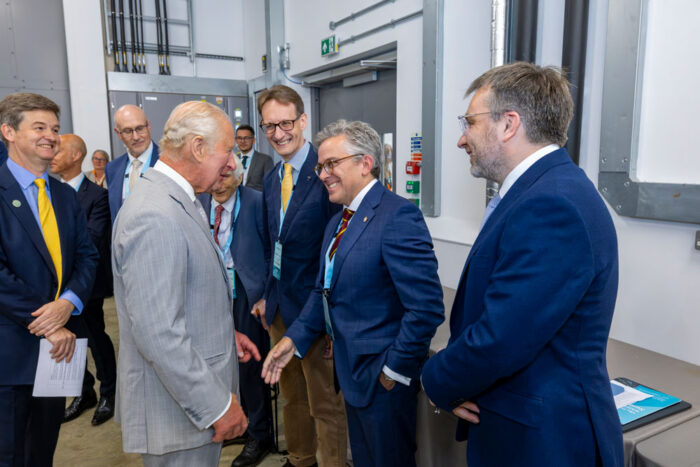
Dr Elliott Grant and His Majesty The King at the opening of the New Whittle Laboratory. Photo by Ian Jones.
The Bennett Innovation Lab is co-led by Trinity Hall alumnus Dr Elliott Grant (Engineering, 1990), alongside Professor Rob Miller. Its work focuses on identifying potential breakthrough applications of aerothermal research, backing small teams to explore high-risk ideas quickly, and building partnerships with investors and industry to take the most promising projects to scale.
Dr Grant described the Bennett Innovation Lab as “a radical experiment in commercialising deep tech/hard tech research”, designed to complement existing technology-transfer routes. Drawing on lessons from innovative technology organisations, including Google X where he previously worked, the Lab will combine small teams, AI tools, rapid testing through the Whittle’s new facilities, and early-stage capital to explore new technological opportunities.
“Our ambition is to launch two to three missions a year,” he said. “We are strictly focusing on missions that are in the aerothermal domain – think aerospace, aviation, energy – that can be built in the UK, and can be material in terms of enterprise value, jobs and impact. It’s audacious, but this is the time to shoot high.”
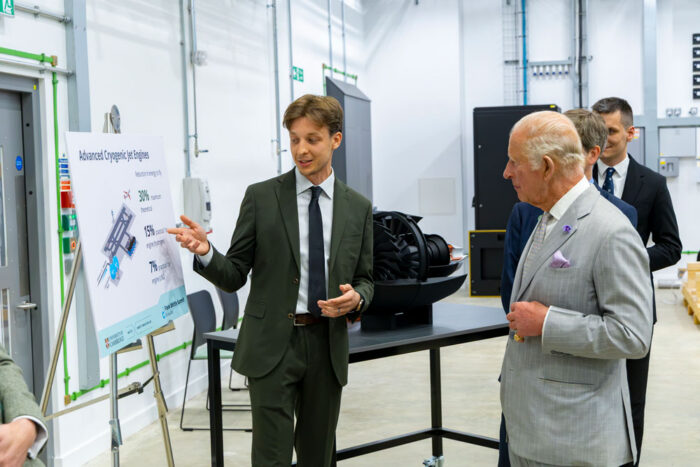
Dr Nathan Clark and His Majesty The King at the opening of the New Whittle Laboratory. Photo by Ian Jones.
Dr Nathan Clark (Engineering, 2015) has also been closely involved in the first Bennett Innovation Lab projects. Professor Pullan described him as “an absolutely key part” of that early work, adding: “I was his supervisor as an undergraduate but I’m definitely learning from him now.”
Professor Pullan said the official opening had been a valuable opportunity to celebrate the new facility and focus attention on the work ahead.
“We’ve been in the building since October 2025, but the official opening has been a fantastic opportunity to celebrate the New Whittle Lab and bring people together to plan which challenges we can tackle together,” he said.
The Trinity Hall connections reach back over several decades. Dr Grant studied thermodynamics under Professor John Denton at Trinity Hall in the 1990s and first met Graham Pullan at the College during the same period. He described Trinity Hall as having “a storied history of excellence in aerodynamics” and said it was humbling to work with such talented colleagues from the same college community.
Professor Pullan added: “It’s great to have Elliott back in Cambridge – we first met at Trinity Hall in the 1990s.”
Their involvement reflects a long-standing Trinity Hall connection with engineering and innovation, as alumni and researchers contribute to work tackling some of the most significant technological and energy challenges facing society today.