Trinity Hall PhD student helps close in on the ‘zeptoverse’
Posted:
26 Nov 2026
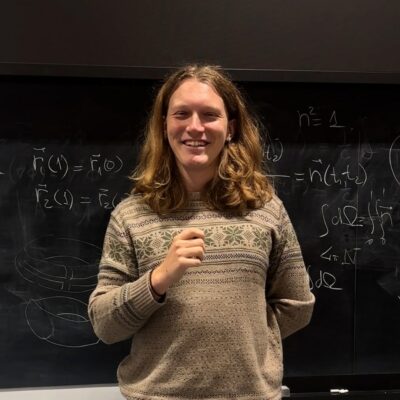
Samuel Haken, a PhD student at Trinity Hall, played a key role in a Cambridge-led project at CERN that found evidence for the rarest decay of a subatomic ‘beauty’ particle ever seen. The result could open a window onto the ‘zeptoverse’, a so-far theoretical realm where undiscovered particles that may hold answers to the nature of dark matter and the origins of the Big Bang could be hiding.
Sam works on the LHCb experiment at CERN’s Large Hadron Collider (LHC) near Geneva, as part of an international collaboration studying beauty quarks, a type of elementary particle and a building block of matter. On 3 November, the team presented evidence for an extremely rare decay of the beauty particle (the B meson) into two muons. The decay occurs in only about one in every ten billion beauty-particle decays, and physicists have been searching for it since 1984.
Sam joined the project at the very start of his PhD, as the analysis was getting under way. The work was led by his supervisor, Dr Harry Cliff, who carried out similar analysis on earlier LHCb data for his own PhD. Of the 19 people working on the measurement, Sam was responsible for measuring the decay’s “effective lifetime” which is essentially how long it takes the B meson to decay into two muons. This measurement acts as an independent cross-check that complements the main search for the rate of decay.
“Harry and I were the only people working on the lifetime measurement,” Sam says. “Working through tough problems, getting stuck and having to retry many times was common, but ultimately worth it, as we had a piece of work that was truly our own.”
The team’s findings bring physicists closer to testing ideas that have only existed in theory. The LHC can probe distances down to about a hundred zeptometres, and its failure to find any new particles suggests they may be smaller still. The decay Sam’s team studied is so rare that even a slight nudge from undiscovered particles could change how often it occurs. By measuring how often the decay happens, the team can look for anomalies and infer the presence of new particles, even if the LHC is not powerful enough to see them directly. Such particles could shed light on some of physics’ biggest unanswered questions, like why dark matter exists and how the universe came to be.
With this under his belt, Sam is already looking to the future. A major upgrade planned for the 2030s will allow LHCb to collect far more data and measure the decay with greater precision. “If there’s a crack in our understanding of the universe, rare decays like this are one of the places we’re most likely to spot it first,” he says.
To anyone considering studying physics, he offers this advice:
“The field of particle physics and Cambridge are first and foremost places of learning rather than a final stop on an academic path. They encourage you to put your neck out and make mistakes to learn from and grow your understanding of your chosen subject. It is far more important to be curious and genuinely interested in furthering your knowledge than to be the most technically proficient or experienced candidate. Everyone starts somewhere, and for many that place is Cambridge.”
Sam isn’t the only Trinity Hall physicist working at CERN. Read more about PhD student Ella Wood’s involvement in the LHCb Collaboration.