A physicist at CERN
Posted:
08 Oct 2026
Person wearing a safety helmet stands inside the CERN Large Hadron Collider, gesturing beside equipment marked “LHCb”.
Walking into Trinity Hall’s historic Front Court as an anxious, excited 18-year-old about to start my undergraduate studies in the midst of the COVID-19 pandemic, I could never have imagined that six years later I would be spending a year working in Geneva at CERN, home to the world’s largest particle accelerator, as part of a PhD in particle physics.
At the time, I knew I found science fascinating and wanted to learn how the world around us works. Not knowing where to focus my attention, I relished the opportunity to continue studying subjects across the sciences through the Natural Sciences tripos. However, after a year of studying chemistry, physics, materials science and maths remotely from my P staircase bedroom I discovered, much to my dismay, that the chemistry I’d been excited by at school was really quantum physics! From there my journey into particle physics began, as I became captivated by our ability, as humans, to understand the smallest building blocks of our Universe. Despite my dwindling love for chemistry, thanks to my supervisor Dr Nick Bampos I gained something invaluable from those first-year chemistry supervisions: an aspiration to “be intellectually ambitious”. It’s a motto that now sits on a pink sticky note on my desk at CERN and has helped get me through some of the hardest moments of my degrees so far.
I have found role models and mentors hugely important whilst navigating my path into physics. From Trinity Hall Fellows, including my undergraduate Director of Studies, Dr Bill Balunas, and Tutor, Dr Gwen Wyatt-Moon, to my Master’s project supervisor, Dr Paula Álvarez Cartelle, and current colleagues, I have been greatly inspired by working with some truly incredible scientists who remind me what is possible on a daily basis. By taking an interest in me and my work, they gave me a space to question, learn and grow which I will always cherish. It is without a doubt their support which means I am sitting here writing this article today, on the balcony of my flat in Geneva.
But what am I doing in Geneva? For my PhD, I am a member of the Large Hadron Collider beauty (LHCb) Collaboration which runs the LHCb experiment 100m underground on the Large Hadron Collider (LHC) at the European particle physics laboratory, CERN. Here we are trying to understand the nature and origin of our Universe, by studying some of the smallest building blocks of matter, specifically a type of particle called beauty quarks. When protons travelling close to the speed of light collide at the heart of the LHCb detector, they produce vast sprays of particles, some of which contain beauty quarks. By studying hundreds of different decay processes of these particles with unprecedented precision, we can probe the fundamental nature of our Universe. I am especially interested in understanding why the Universe is made of matter. Our best theory suggests that matter and antimatter (the twin of matter with equal mass and opposite charge) were produced in equal quantities during the Big Bang. However, matter and antimatter also annihilate each other in pairs, leaving only energy. Therefore, without a violation of the symmetry connecting the two, we would expect all the matter to have annihilated with antimatter, leaving an energy filled Universe with no matter, and therefore no us! The symmetry that must be broken to generate this excess of matter over antimatter, is called charge-parity (CP) symmetry. My research focuses on studying the violation of this symmetry in specific decay processes in data collected using the LHCb detector.
For me, one of the highlights of being in Geneva has been getting to participate in operating the 5600 tonne LHCb detector! Whilst the LHC is running, despite significant automation, we need two people in the LHCb control room to operate the detector 24/7. I’ve been lucky enough to take shifts both managing the quality of the data in real time and running the detector itself. Additionally, I undertook training to troubleshoot and recover the most common issues expected in one of our subdetectors, the RICH (or Ring Imaging Cherenkov) detectors which are particularly exciting as they allow us to identify different types of particles by measuring their velocity and thus inferring their mass. Being able to identify different particle species is crucial for us to study so many different decay channels with high precision.
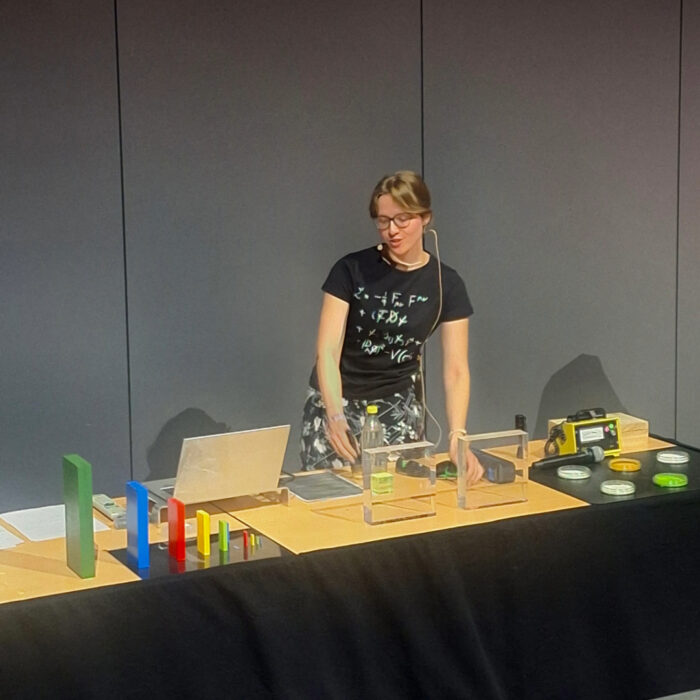
Ella Woods presenting her first science show to an audience of almost 200 people in the Science Gateway at CERN.
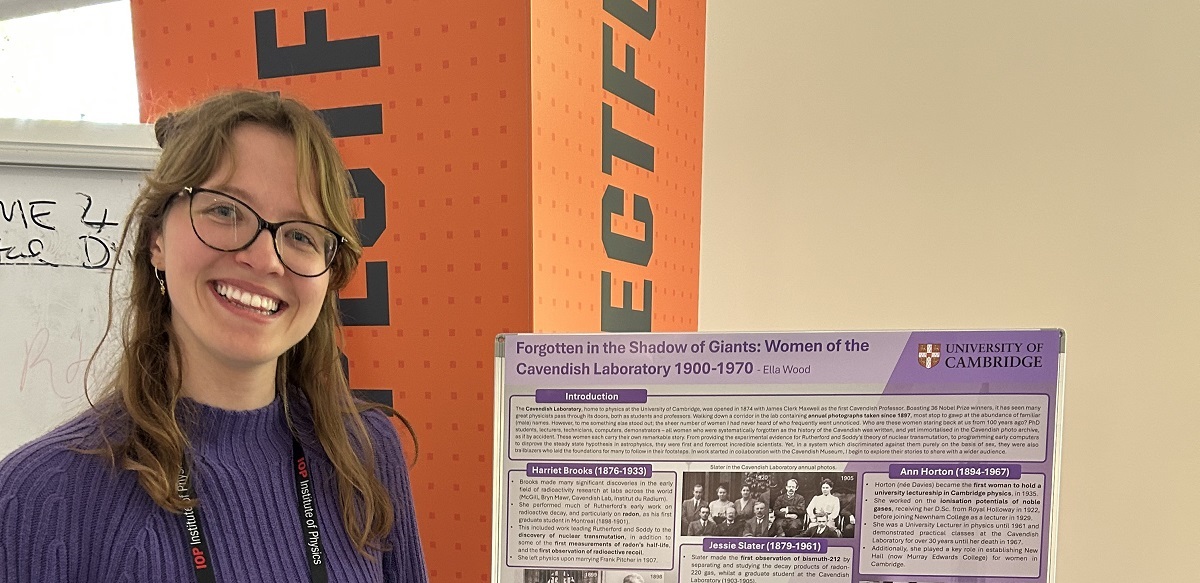
Beyond my research, I am very passionate about outreach and equal opportunities in STEM. Guiding tours of the LHCb experimental cavern has been incredibly special, as has presenting science shows in the Science Gateway, CERN’s education and outreach centre. I am also actively involved in the Cambridge University Women in Physics Society and LHCb’s Early Career Gender and Diversity Office. I strongly believe that physics is a human endeavour, woven with human stories which cannot be disentangled from the science itself. This has led me to start researching the history of women at Cambridge’s Cavendish Laboratory to share their stories with a wider audience, including in the newly re-displayed Cavendish Museum. Women remain a minority in physics and their voices, along with those of all underrepresented groups, deserve to be heard, both past and present. Through building supportive networks, creating opportunities for, increasing visibility of and actively listening to these communities, I believe we can build an environment where everyone can thrive in physics.