Elizabeth Geldart: a Master’s wife and her books
Posted:
19 Oct 2026
As Trinity Hall marks fifty years since the admission of women, it is worth remembering those who shaped the College long before they could belong to it. One such figure is Elizabeth Geldart, wife of Thomas Charles Geldart, Master of Trinity Hall. Although she held no formal position within the University, Elizabeth occupied a prominent place in College life, was a generous donor, and left behind a gift of books, now preserved in the Old Library.
Born Elizabeth Cooke around 1810 in Pendlebury, near Manchester, she married Thomas Charles Geldart on 23 August 1836. Charles, as he was known, was the son of a clergyman from Kirk Deighton in the North Riding of Yorkshire. He was educated at Trinity Hall and was a Fellow there from 1821 until his marriage to Elizabeth in 1836, which obliged him to resign his fellowship. After his election to the Mastership of Trinity Hall in 1852, he returned to the College, holding the position for twenty-five years until his death in 1877.
Geldart was not remembered as a great reforming Master, but he was widely regarded as kind and convivial. Unlike some of his predecessors, he resided in College during term-time and frequently entertained undergraduates in the Lodge, offering generous hospitality alongside substantial quantities of port and sherry. Perhaps because of this he was generally popular. According to Elizabeth, as recorded by Charles Crawley, his final words were: “You will let the undergraduates have some of the old sherry.”
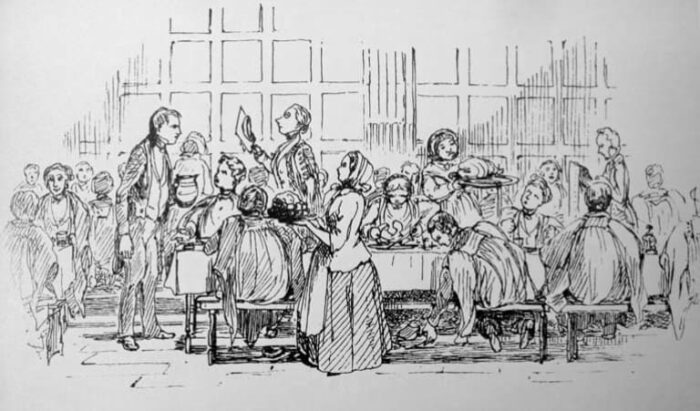
Early nineteenth-century engraving of dinner at Trinity Hall, published by Storer and Storer c.1825
As the wife of a Head of House, Elizabeth occupied a position of high status in Cambridge. Masters’ wives played an important part in the social and ceremonial life of the University, hosting dinners, receiving visitors, and maintaining the networks of friendship that connected academia. Contemporary accounts suggest that Elizabeth and her husband embraced these responsibilities with enthusiasm, selecting the menus, and overseeing the famous “Christmas exceedings” – huge meals for fellows and scholars served daily at 5:00pm and again at 10:00pm between Christmas and New Year.
The suffragist and co-founder of Newnham College, Millicent Fawcett met the Geldarts through her husband Henry Fawcett’s connection to Trinity Hall. She later recalled them in her memoir What I Remember as like figures from a much earlier age “even to the eighteenth-century”. Her portrait of Elizabeth is gently comic: a dedicated traditionalist, deeply attached to monarchy and established customs, and firmly opposed to women’s suffrage.
In March 1872, Elizabeth presented eight books to the College Library. Four of them had been given to her by Sir Thomas Talfourd, the judge, politician and playwright whose circle included literary figures such as Robert Browning, Charles Dickens, William Makepeace Thackeray and William Wordsworth. Among them are copies of his The Dramatic Works (1852), The Castilian (1853), Vacation Rambles (1851), and its later supplement (1854). Each volume bears a personal inscription from Talfourd to Mrs Geldart, suggesting a friendship that extended beyond mere acquaintance.
The collection also contains two books presented to Elizabeth by William Whewell, Master of Trinity College (1841-66) and one of nineteenth-century Cambridge’s most celebrated intellectuals. Both bear the simple inscription: “Mrs T. C. Geldart from the author.” One is Whewell’s Of the Plurality of Worlds: An Essay, a contribution to one of Victorian Britain’s most popular scientific and theological debates. The other is his translation of The Professor’s Wife, a novel by the German writer Berthold Auerbach.
More revealing still is another volume associated with the Whewell family. Following Whewell’s death in 1866 after falling from his horse, his sister sent Elizabeth a book of Shakespeare’s works containing a handwritten message of thanks. Pasted inside is a moving inscription acknowledging “Mrs E. Geldart’s soothing attentions in the hour of sorrow” following her brother’s death. It is a small piece of evidence, but one that preserves an act of kindness and friendship. The book had previously belonged to, Lady Affleck, Whewell’s second wife who had predeceased him.
The final volume in the collection is a privately printed work by the editor Richard Chenevix Trench, Dean of Westminster, drawn from the journals of Melesina Chenevix St George Trench. Sent to Elizabeth after a visit to the Master’s Lodge, it demonstrates once again how books functioned as tokens of friendship and remembrance in Victorian society.
Taken together, these eight volumes preserve traces of relationships that would otherwise have been lost and reveal a woman whose influence was exercised through hospitality, friendship, and personal connection. While the official records of Trinity Hall tell us much about Masters, Fellows, and students, these inscriptions allow us to recover something of the individuals who inhabited the social world around them.
Elizabeth’s generosity to the College extended beyond her gift of books. In 1876 she funded the redecoration of the Chapel, paying for stained glass, gilding, and a fresco of the Baptism of Jesus upon the west wall. She died in 1883, bequeathing pictures, furniture, and engravings to the Master’s Lodge in her will.