George Bridgetower, 1778-1860
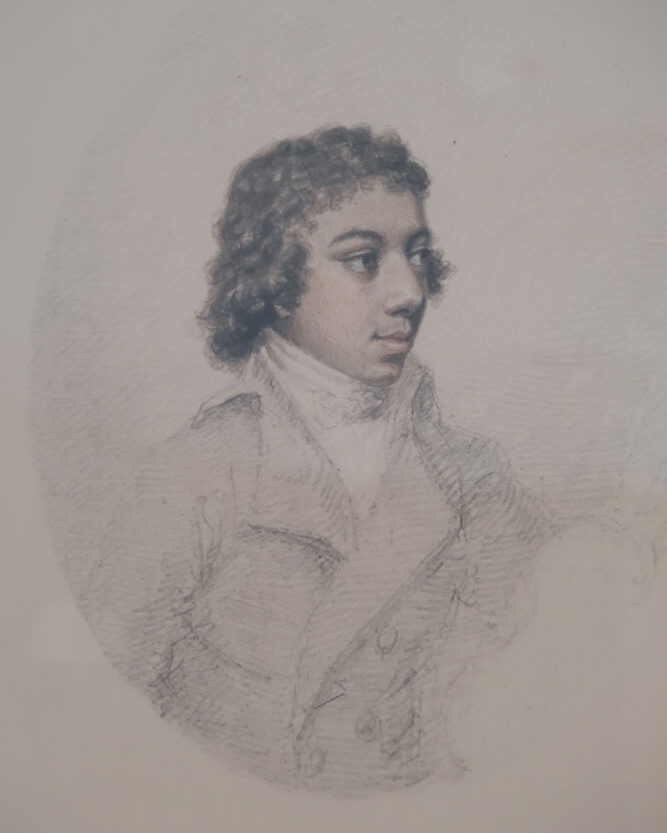
George Bridgetower (or Bridgtower, as he and his contemporaries spelled his name, the spelling varies) is one of the earliest documented Trinity Hall Black alums. George Augustus Polgreen Bridgetower (1778–1860) was virtuoso violinist born in Poland to an African father (who came to Europe from Barbados), Joanis Fredericus de Augustus, and a Polish or German mother, Maria Ursula de Augustus (née Schmid). One of the most famous musical performers of his era, in the early 1800s Bridgetower was a close friend of Beethoven’s, who first dedicated what is now known as the Kreuzer Piano and Violin Sonata (Opus 47) to him.
Bridgetower was born on 13 August 1778 and baptised on 11 October 1778 at the court of Prince Hieronimus Wincenty Radziwiłł in Biala Podlaska in eastern Poland, where his father was a high-ranking servant. Shortly after George’s baptism, his family moved to Austria, where his father was employed by the music-loving Prince Nicolas Esterházy at his estate at Eisenstadt. George, a musical child prodigy, may have studied for a few yearsunder Haydn who was then the Esterházy family’s Kappellmeister. By spring 1786, when George was seven, his family had moved to Frankfurt, where he gave his first recorded public debut on 5 April 1786. Shortly afterwards, they settled in the flourishing musical centre of Mainz, where his father became an employee of the Archbishop of Mainz. George may have had violin tuition from Ernst Schick, Chamber Virtuoso and first violinist to the Prince-Elector and Archbishop of Mainz.
In late 1788, George set off with his father on a well-documented musical tour of European cities where he performed as a violin prodigy – Kleve and Liège (December and January 1788); Brussels (February 1789); the Hague (March 1789); and Paris as part of the ‘Concert Spirituel’ series on 11 April 1789. The unstable political situation in France forced George and his father to flee to Britain, where he performed at fashionable venues in Brighton (August 1789) and then Windsor, Bath, Bristol and London (autumn 1789 to spring 1790), advertised as ‘The son of the African Prince’. He quickly came to the attention of George Augustus Frederick, Prince of Wales, and following neglect by his father, was taken into the custody of the Prince in late 1789.
George was brought up in the royal household at Carlton House and, from 1791, studied violin under both François-Hippolyte Barthélémon (orchestra leader at the Royal Opera) and Giovanni Giornovichi (Ivan Jarnovic) and musical composition under the English composer William Attwood, a protégé of the Prince of Wales, former pupil of Mozart, and music teacher to the Duchess of York (1791) and Princess of Wales (1795). From 1795 until 1809, George was a salaried member of the Prince of Wales’s private chamber ensemble (‘band’) and he divided his time between Carlton House and The Royal Pavilion in Brighton. He further supplemented his quarterly salary by private and public performances. He soon became a respected member of London’s musical community as violinist, piano teacher and composer.
In 1802, George obtained royal permission to visit his mother and younger brother in Dresden, from where he proceeded to Vienna. It was here, in spring 1803, that he met the German pianist and composer Ludwig van Beethoven. Evidently there was great professional and personal sympathy between the two musicians, and Beethoven composed a new and particularly challenging sonata for him, which they premiered togetheron 24 May 1803. The original dedication read: ‘Sonata mulattica composta per il mulatto Brischdauer [sic], gran pazzo e compositore mulattico’. However, the dedication was swiftly withdrawn following a quarrel and the complete sonata was published in 1805 as Op.47, with a dedication to the French violinist Rodolphe Kreuzer, who apparently was unable to perform it due to its technical difficulty.
Bridgetower continued his performing and teaching career in London and other cities in England. Through recent research undertaken by Professor Victoria Avery of the Fitzwilliam Museum, we now know that Bridgetower had a long-standing friendship with the Cambridge Professor of Music, Charles Hague (1769–1821), who was a fellow of Trinity Hall. As a result, Bridgetower performed in over 15 public concerts organized by Hague in Cambridge from May 1795 until June 1811. It was also under Hague’s encouragement and tutelage that George was awarded the degree of Bachelor of Music from the University in June 1811. The examination for the BMUs degree took the form of a ‘composition exercise’, on this occasion a setting for chorus and orchestra of an anthem by F.A. Rawdon entitled By Faith Sublime Fair Passiflora Steers her Pilgrimage Along This Vale of Tears. The first performance took place on 30 June 1811 in Great St. Mary’s Church, before the newly elected Chancellor. Sadly, the manuscript of this work is lost, but a contemporary reviewer commented that ‘The composition was elaborate and rich; and highly accredited the talents of the Graduate. The trio struck us, particularly, by its beauty.’ Bridgetower wrote many other compositions, including for the solo violin, chamber ensembles, and orchestral works as well as piano exercises for students and ballads for voice and piano, but sadly only a handful of scores survive.
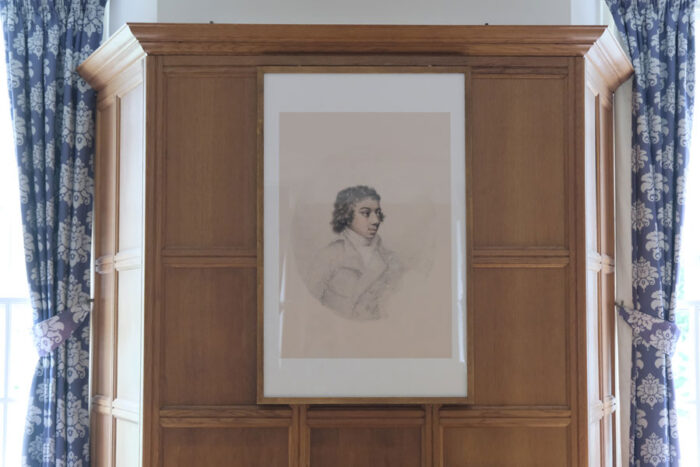
Bridgetower has a room named after him in Trinity Hall’s first court, which displays a reproduction of one of the only two likenesses known of the musician: as a young adolescent likely made for the Prince of Wales. The other portrait (now in the Morgan Library, New York) is an exquisite portrait miniature of Bridgetower in his mid-twenties: an inscription on the reverse reveals that it was commissioned by Bridgetower and given by him to Professor Hague in 1805. Bridgetower featured in Cambridge University Library’s Black Cantabs: History Makers exhibition in 2018, and in the Fitzwilliam Museum’s Rise up! Resistance, Revolution, Abolition exhibition in 2025.
Bridgetower continues to inspire classical musicians and is increasingly recognised not only as a pioneer performer of African descent in an era when access to almost exclusively European dominated music circles was difficult, but also as innovative performer who contributed to a musical revolution at the turn of the 19th century. In 2009, the former U.S. Poet Laureate Rita Dove published a collection of poems inspired by Bridgetower’s life, Sonata Mulattica : A Life in Five Movements and a Short Play. More recently, Professor Nicole Cherry a violinist and musicologist at the University of Texas at San Antonio, created the commissioning project Forge with George which commissions pieces inspired by Bridgtower’s work and that of his wider circle.
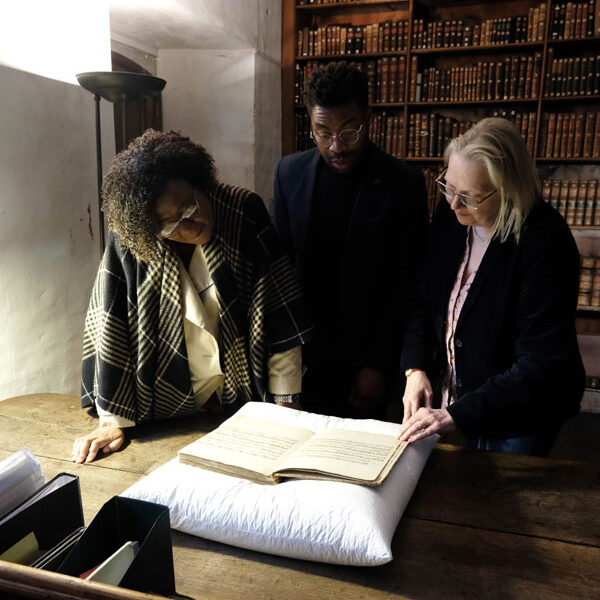
In March 2025, Trinity Hall was delighted to host Professor Victoria Avery and Dr Nicole Cherry, who presented their ongoing research into Bridgetower’s life, work and Cambridge connections, and Nicole performed various passages of his compositions, accompanied by Dr Wayne Weaver, as part of a series of events relating to the work of the college’s research into Legacies of Enslavement.
George Bridgetower is also the inspiration behind an annual essay competition for current and recent self-identifying Black Cambridge students. The essay competition, launched as a partnership between the University’s Black Advisory Hub and the Alexander Crummell Fund aims to provide a space for reflection on the Black experience at Cambridge. Titles are announced in Easter Term with a deadline of September each year.
Words by Professor Pedro Ramos Pinto and Professor Victoria Avery.