As Trinity Hall marks 50 years since the admission of women, a new PhD studentship will support women in underrepresented subjects, currently STEM and economics. The lead gift grows out of one alumna’s experience in rooms where women’s perspectives were missing.
Who gets to shape the future?
Posted:
08 Oct 2026
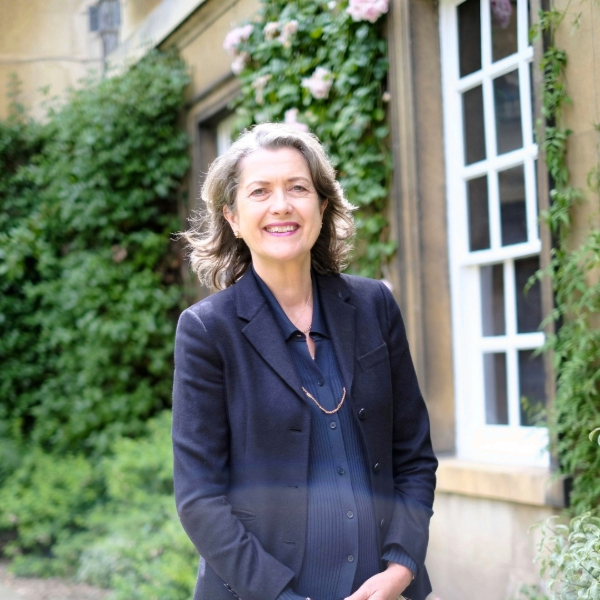
When Catherine Stewart (1977, Economics) began her career in political consulting in the 1980s, her work took her through London, Brussels and Washington DC, in environments she remembers as “almost exclusively male”.
“When you are the only woman in the room you don’t ‘see’ yourself as a minority,” she says. “But as more women appeared in senior positions, I realised what had been missing and how different the dynamics could be.”
“It was a sort of relief,” she says, “to see other women operating in the way I did and to realise the unacknowledged and undefined challenges of being a woman in the men’s world.”
Those reflections have shaped her decision to make a lead gift towards a Trinity Hall PhD studentship for women in underrepresented subjects. The gift gives the initiative a concrete foundation from which others can help build a fully funded studentship, covering fees and living costs.
Women need to be present where decisions about society, technology and the economy are made. “Tech and politics are defining 21st-century society and the world economy. Women in research, teaching and leadership ask different questions, highlight different challenges and prioritise different issues,” Catherine says.
Her own career included moments when she had to decide how to continue in a world largely shaped by men. Early on, after being undermined by a male colleague she had trusted, she resigned and set up her own business. Her reaction was direct: “Well, **** them – I can do this better on my own.”
And she did, though she is careful not to present success as something achieved alone. Her work was supported by others, including her deputy, a man who was, in her words, “happy to work for a woman”. Her experience has left her with a clear view that women’s contributions need to be recognised as integral to research, policy and professional life.
Professor Sasha Turchyn, Trinity Hall’s Postgraduate Tutor, sees how much the right support can matter to women considering doctoral study. In subjects where women remain underrepresented, an academic future can be harder to imagine.
The decision to undertake a PhD often comes when students are weighing academic ambition alongside the kind of life and career they want to build. Sasha describes the PhD as “a marathon and not a sprint”, requiring independent thought, persistence and the ability to work through uncertainty.
“The PhD prepares someone to be a problem solver,” she says, “and to not be afraid to exist in a place of uncertainty, where they need to riddle through clues to figure out the answer.”
Women remain underrepresented at PhD level in STEM subjects and economics. In 2023, only 38.7 per cent of STEM PhD admissions at Cambridge were women.
A fully-funded studentship gives the recipient the ability to say yes to doctoral study without piecing together support through loans, grants or part-time work. “Given the PhD is so challenging anyway, taking away the financial pressures makes a tremendous difference,” Sasha says. “A fully-funded studentship allows the student the flexibility to fully engage with their research.”
Master Mary Hockaday is herself an alumna, part of the early generation of women who came to Trinity Hall after they were first admitted in the late 1970s. “It set me up for life in so many ways,” she says.
The College has since made progress in increasing the number of female Fellows, including in STEM subjects. Even so, Mary says: “One thing that hasn’t changed, right across education and employment, is that female students are underrepresented in some STEM and other subjects.”
Supporting women at postgraduate level is a necessary and practical response, says Mary.
Women were first admitted to Trinity Hall in 1976 as Fellows and postgraduates, followed by undergraduates in 1977.
Fifty years later, the College is looking at what progress has been made so far and where support is still needed.
Catherine sees the studentship as one way to extend opportunity. Even where role models are not yet obvious, she believes women can become them for those who follow. “There is confidence and strength in numbers,” she says.
Her lead gift begins the work of endowing the studentship, while leaving room for others to help secure and sustain it. Catherine says:
Fifty years after women first came to Trinity Hall, the studentship offers a way to mark that history through practical support for the next generation. Further support will now determine its reach.

To ensure that we can fully fund the studentship in perpetuity, we are encouraging supporters to make a gift to the PhD studentship for women in underrepresented subjects.