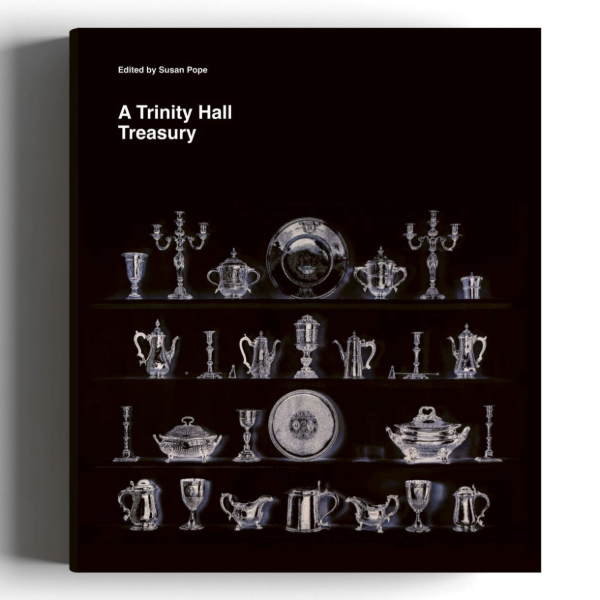
The following passages are taken from a longer article in A Trinity Hall Treasury exploring the history and significance of the Trinity Hall silver collection.
The silver collection
Posted:
08 Oct 2026
Written by:

Historic display of silver tableware arranged on four shelves, including cups, candelabras, teapots, candlesticks, serving dishes and plates, shown in a sepia-toned photograph.
Treasure comes in different shapes and sizes. The term’s etymological link to the word thēsaurus (in Latin) and thēsaurós (in Ancient Greek) suggests that treasure need not even be something tangible: it can be words or concepts, the value of which stems from their being part of a collection, and from the potential pleasures of finding one thing while looking for another.
On the (well-polished) surface of things, the silver of Trinity Hall might appear to be treasure in the most straightforward sense of the word. The value of the objects is self-evident: housed in the College’s vaulted safe, their preciousness stems from the quality of silver and the expertise of craftsmanship, and the collection includes works by some of the finest British silversmiths of the past centuries. Yet it is not these characteristics alone that lend the silver collection, often called the College’s ‘plate’, the status of treasure. There are over 260 items dating from 1300 to the present day, objects which have been commissioned, bequeathed or donated to the College, or purchased for specific purposes.
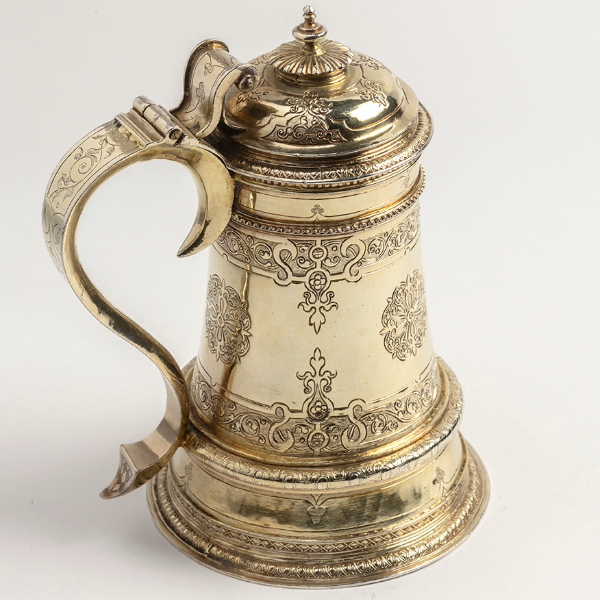
One of the oldest items in the collection is a tankard from 1570 that was gifted to Trinity Hall by Matthew Parker, Archbishop of Canterbury, chaplain to Anne Boleyn, and Vice-Chancellor of Cambridge University. It is unsurprising that the silver of the collection often relates to drinking and feasting, for these activities – until recently, principally the domain of men – have been fundamental in the preservation of tradition and the fostering of connections within and beyond the College.
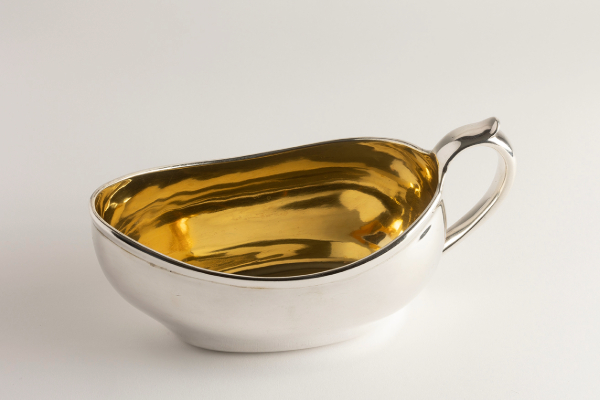
The preponderance of silver for dining has, at times, caused confusion. For instance, a silver bowl from 1716 with a flat handle and decorated with a winged stag’s head bears a striking similarity to a porringer (a shallow bowl) – of which the College has many – and was catalogued as such for some time. But this is, in fact, a bleeding bowl (or bloodletting bowl), gifted to the College by former surgeon general Colonel Spencer. One former Trinity Hall butler has also claimed that the 1845 bourdaloue (a travelling chamber pot for those wearing skirts) gifted to the College to ‘celebrate’ the admission of women was, at one point, used as a gravy boat, which is perhaps unsurprising given its rounded shape, its handle and its place in the silver safe among the sauce boats and soup tureens
Though the College now commissions far less silver than in the past – a notable exception being Cornelia Parker’s tapestry – Fellows continue to donate objects when they leave or retire, and these are often contemporary pieces.
Ultimately, it is not only the pleasures of discovering synonymic silver objects like tankards, mazers and tuns that contribute to the treasure-like quality of the collection. If, as I suggest, the collection can be viewed as a kind of thesaurus, where one looks for one thing in the hope of finding another, then the infinite and surprising stories that would undoubtedly emerge from researching a single object are of great value. While this short piece discusses the collection in the context of the College and its social history, the production of silver – like tea, coffee and tobacco – is part of a history of empire and global trade, a history that extends far beyond the walls of Trinity Hall.