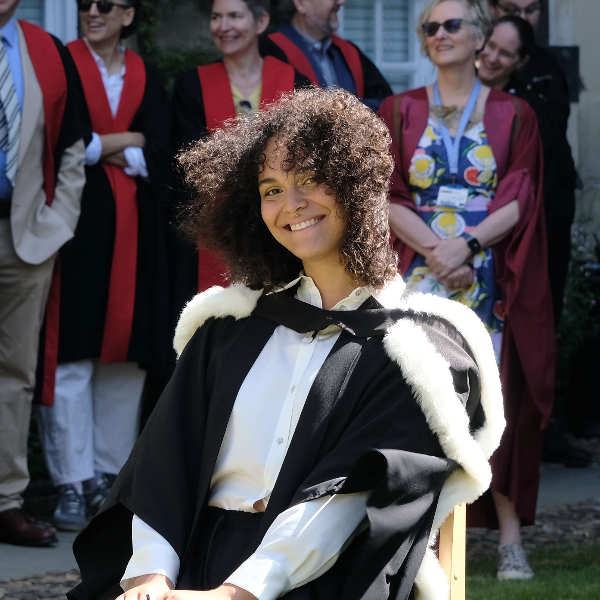
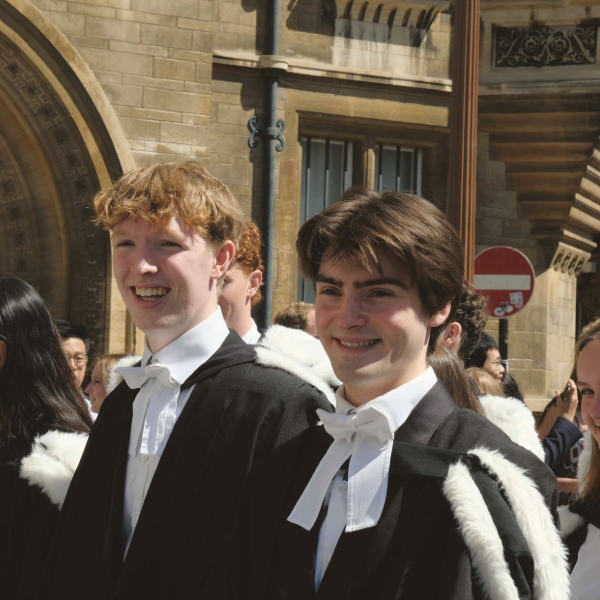
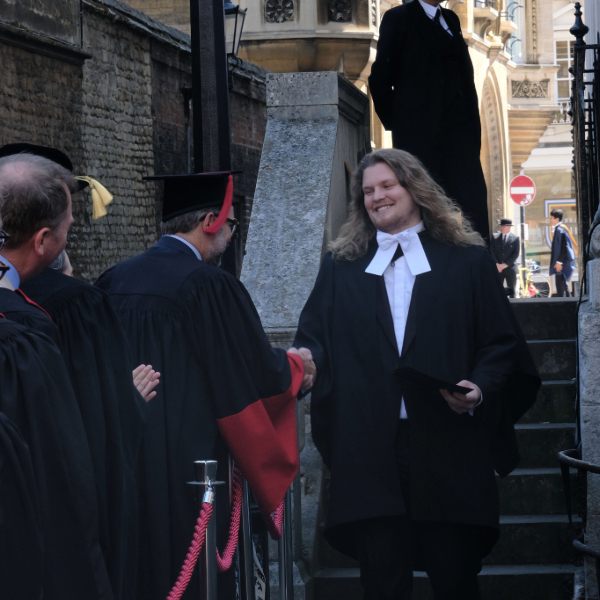
The Trinity Hall flag flies on a hot July day as 105 graduands line up in Front Court before the walk to the Senate House where they will officially become graduates of the University of Cambridge.
The Praelector
Posted:
08 Oct 2026
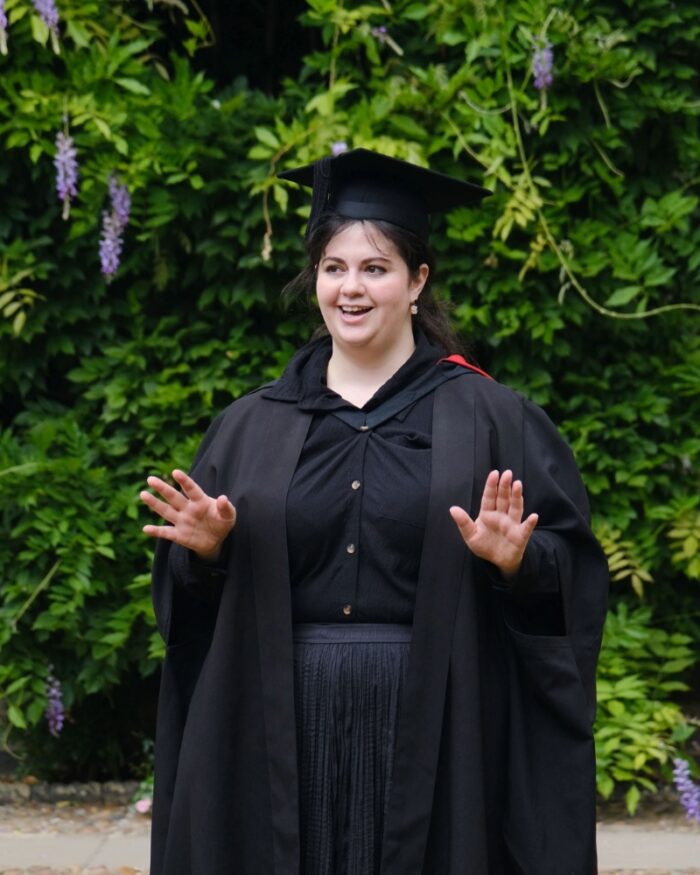
Dr Suf Amichay in her role as Praelector.
A hush settles over the group as students stand together in their gowns, listening closely as the instructions begin for this year’s General Admission. Members of College are gathered around the edges to watch the familiar scene take shape, this time with a new leading voice.
Dr Suf Amichay, Praelector for Trinity Hall this year, stands with the graduands and talks them through what will happen next. She explains where they will stand, when they will move and what they will need to do once they are inside the Senate House. Before the practical instructions, she takes a moment to acknowledge what has brought them there.
“You can think back on the last few years and know that you’ve done something extremely hard and completed it,” she tells them. “I hope you know that the College is really proud of you. You are part of this long tradition of people who come and seek knowledge and pursue it for yourself. In the spirit of medieval things, I’m going to now walk you through this ceremony, which, as you can see by the clothes you are wearing, is not a modern one.”
That mix of reassurance, instruction and ceremony is close to the heart of the Praelector’s role.
The word praelector is Latin in origin, generally understood as someone who reads out, lectures or speaks before others. At Cambridge, the Praelector is both a practical and ceremonial role. They prepare graduands before their graduation ceremony and speak on behalf of the College at the point when a student’s achievement is formally recognised by the University. The office sits within the long ceremonial history of Cambridge. The University describes elements of the degree ceremony as having their origins in its earliest customs, around 800 years ago, and Latin remains part of the formal proceedings today. Much has changed in the life of the University since then, but graduation still preserves a strong sense of order and continuity through the procession, the sequence of colleges, the formal presentation, and the recognition of graduands as members of a College as well as the wider University. Our Archive holds a definite reference to praelectors from 1882, but as Cambridge’s fifth oldest college it’s likely praelectors have been part of Trinity Hall life for much longer.
One of the most distinctive parts of the ceremony is the Latin. The Praelector presents each graduand in turn by taking their hand and saying:
“Dignissima domina, Domina Procancellaria et tota Academia praesento vobis hunc virum (hanc mulierem) quem (quam) scio tam moribus quam doctrina esse idoneum (idoneam) ad gradum assequendum (name of degree); idque tibi fide mea praesto totique Academiae.”
“Most worthy Vice-Chancellor and the whole University, I present to you this man (this woman) whom I know to be suitable as much by character as by learning to proceed to the degree of (name of degree); for which I pledge my faith to you and to the whole University.”
For most graduands, the Latin may be remembered as part of the atmosphere of a ceremonial tradition but for the Praelector it has to be accurate, fluent and timed with care. As Suf leads the graduands out of Front Court to a chorus of applause, the practical preparatory work of the Praelector gives way to ceremony. Under the early afternoon sun, they process down Trinity Lane and along Trinity Street to the Senate House for the formal moment they become graduates.
For alumni, that moment may be sharp in the memory or almost lost among the photographs and congratulations that followed. Either way, it is part of the passage from student to graduate, with their Praelector guiding them through one of Cambridge’s oldest ceremonies.