Natural Sciences
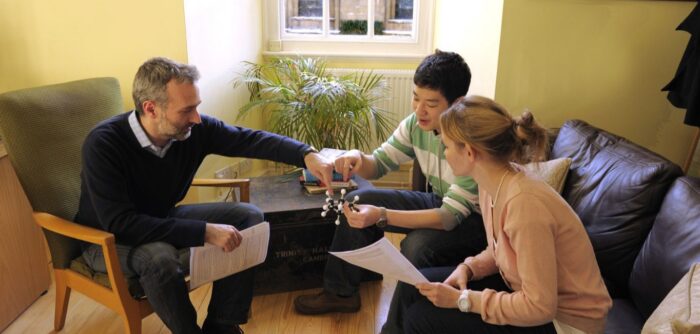
Natural Sciences offers a wide range of physical and biological science subjects from multiple departments in a unique and demanding course. A broad first year is combined with increasing specialisation in the second year and the possibility of total specialisation in the third year.
The breadth of the course reflects the blurring of boundaries between the different sciences and before committing yourself to one department you study a variety of subjects, some of which may be new to you. This means you can change your mind about which subject to specialise in.
- UCAS Code: BCF0
- Campus Code: 4
- Duration: 3-4 years
- Places per year: 18-20
Entry requirements
Minimum offer level
A-Level: A*A*A
IB Diploma: 42 points, with 776 at Higher Level
Please also read our Entry Requirements page.
Subject requirements
You will need A levels/IB Higher Levels (or the equivalent) in:
- Mathematics
- 2 other science or mathematics subjects
Please note, ‘science/mathematics subjects’ refers to Biology, Chemistry, Physics and Further Mathematics.
If you are taking the IB Diploma, we will require HL Mathematics Analysis and Approaches if you wish to apply for Natural Sciences Physical. For Natural Sciences Biological, we recommend Analysis and Approaches but we will also consider Applications and Interpretations.
For Natural Sciences Physical we will normally ask for an A* in Further Maths (or an A* in Maths if Further Maths is not being taken) and an A* in Physics or Chemistry.
For Natural Sciences Biological we may ask for an A* in specific subjects.

Why Trinity Hall?
Natural Sciences at Trinity Hall is a large and dynamic community, bringing together students and Fellows working across a wide range of disciplines.
You’ll be part of an active scientific environment with regular talks and events organised by student societies.
The College also has a strong record of scientific achievement among its alumni, reflecting its ongoing commitment to research and discovery.
Natural Sciences at Cambridge
The Natural Sciences Tripos (or NST) at Cambridge embodies a modern, interdisciplinary approach to scientific education. This program serves as the primary framework for teaching science at Cambridge, encompassing a wide range of subjects from biochemistry, ecology, neurobiology and genetics, to physics, chemistry, environmental and materials science.
Admissions process
Written work
None required.
Admissions assessment
All applicants for Natural Sciences are required to take the Engineering and Science Admissions Test (ESAT) at an authorised assessment centre. You must register in advance for this test.
Please see the University’s admissions test page for more information.
Interviews
Two interviews of around 25 minutes each.
When applying for Natural Sciences at Cambridge, you will be asked to indicate whether you wish to apply for Biological or Physical Sciences. This will determine what kind of questions you will be asked at interview. At Trinity Hall, Biological applicants will tend to be asked questions about Biology and Chemistry, while Physical applicants will tend to be asked questions about Maths, Physics and Chemistry.
Each interview will be tailored to the individual and the subjects they have studied at school. However, interviews will cover some new ground as well – we want to see how well you deal with new material and with the application of your background knowledge to new problems.
Biological or Physical?
The Natural Sciences course is very flexible and allows you to try out different subjects before you specialise. In the first year, students can choose any combination of subjects, though some subjects will complement or build upon others.
Biological Sciences first-year subjects:
- Biodiversity, Evolution and Ecology
- Biomedical Sciences
- Biomolecules and Cells
- Mathematics for Biological Sciences
Physical Sciences first-year subjects:
- Chemistry
- Earth Sciences
- Materials Science
- Mathematics for Physical Sciences
- Physics
Read more about each subject on the Cambridge Natural Sciences Tripos website.
You choose three sciences subjects plus a mathematics subject in the first year. You can mix and match biological and physical subjects. If you are mostly interested in the biological subjects, you would normally apply for Biological Natural Sciences. If you are mostly interested in the physical subjects, you would normally apply for Physical Natural Sciences.
Read the Entry requirements section above to make sure you are taking the right subjects at school.
Read the Admissions process section to see which subjects are covered at interview.