Trinity Hall Logo
Hamburger menu icon
Search button Email us button
  • Menu

  • Back
  • Back
  • Back
  • Study with us
    • Study with us
    • Undergraduate Study
      • Undergraduate Study
      • Courses
      • Entry Requirements
      • How to Apply
      • Fees and Finance
        • Fees and Finance
        • Financial Support
        • Living Costs
        • Tuition Fees
      • Open Days, Events and Visits
      • The Admissions Team
      • Prospectus
      • FAQs
      • Student Profiles
      • Access and Outreach
    • Postgraduate Study
      • Postgraduate Study
      • How to Apply
      • Visiting Postgraduate Students
      • Postgraduate Studentships
      • Studentship FAQs
      • Postgraduate Tutorial Office
      • Contact
    • Life at Trinity Hall
      • Life at Trinity Hall
      • Accommodation
      • Food and Drink
      • Support for Students
    • Access and Outreach
      • Access and Outreach
      • Widening Participation Programmes
      • Teachers and Advisers
      • Parents and Supporters
      • Open Days, Events and Visits
      • The Admissions Team
    • Next Steps
      • Next Steps
      • Trinity Hall Virtual Tour
      • Open Days, Events and Visits
      • Prospectus
      • Student Profiles
    • Why Cambridge?
    • Why Trinity Hall?
  • About Trinity Hall
    • About Trinity Hall
    • The College
      • The College
      • History
      • Masters of Trinity Hall
      • Friends of Trinity Hall Society
    • Arts and Music
      • Art
      • Music
        • Music
        • Music Facilities
        • Chapel Choir
        • Music Society
        • Music Awards
        • Professional Music
        • Recordings
    • Library and Archive
      • Library and Archive
      • Jerwood Library
        • Jerwood Library
        • Information For Students
      • Old Library
        • Old Library
        • About the Old Library
        • Visiting the Old Library
        • Supporting the Old Library
      • Archives
    • Facilities
      • Facilities
      • Sport
      • Gardens
      • Chapel and Interfaith Room
      • Library and Archive
    • People
    • Gift Shop
    • College Governance
    • Student Hub
    • Student Wellbeing
  • Alumni
    • Alumni
    • Alumni News
      • Alumni News
      • Obituaries
    • Publications
      • Publications
      • Front Court
      • Trinity Hall Review
      • Working TogeTHer
    • Alumni Benefits
      • Alumni Benefits
      • Accommodation and Events
      • Dining Privileges
    • Alumni Events
      • Alumni Events
      • College Reunions
      • The Cambridge MA Degree
      • Graduation
      • Alumni Events FAQs
    • Alumni Networks
      • Alumni Networks
      • Careers Network
      • Trinity Hall Entrepreneurs Network (THEN)
        • Trinity Hall Entrepreneurs Network (THEN)
        • Case Studies
        • Reports
        • Entrepreneurship Funds and Awards
        • Cambridge Social Innovation Prize
      • Trinity Hall Association
        • Trinity Hall Association
        • THA Volunteering Awards
        • THA Committee
      • Aula Club
      • Trinity Hall Boat Club
    • Trinity Hall Reps
    • Contact the Alumni & Development Team
    • Keep in Touch
    • Gift Shop
  • Supporters
    • Supporters
    • Anniversary Campaign
      • Anniversary Campaign
      • Find Your Cause
      • Your Impact
      • About the Campaign
    • How to Give
    • Get Involved
      • Get Involved
      • Trinity Hall Reps
      • THA Committee
      • Development Committee
  • Conferences and Events
  • News and Events
    • News
    • Events
    • Editor’s Choice
  • Contact Us
    • Contact Us
    • Fellows and Academics Directory
    • Staff Contact Directory
  • Intranet
  • Vacancies
    • Vacancies
    • Postdoctoral Research Associateships
    • Staff Vacancies
    • Academic Vacancies
Home > Publications > Spring 2026 > Publication > Sir Mark Tully – A personal tribute

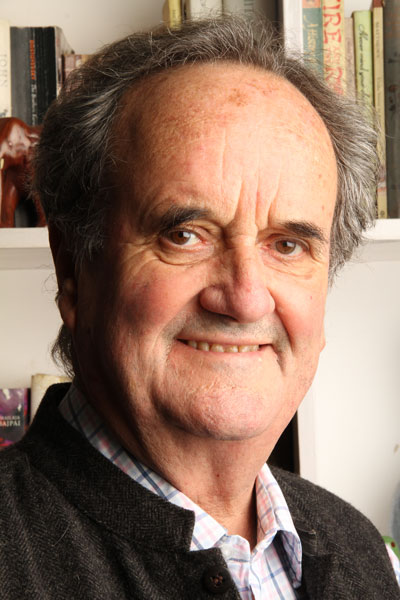
Sir Mark Tully – A personal tribute

Posted:
06 May 2026
Written by:
Dr Vic Forrington | 1955, Mathematics

I first met Mark Tully in a pub in Cambridge and was introduced to him by his roommate at Trinity Hall, who described him as ‘a rather jolly chap’.

Mark was in his first year reading theology after a public-school education and National Service, and I was a second-year mathematics student who had come straight from grammar school. Seemingly, we had little in common. That we became and remained close friends for nigh on 70 years says a great deal about his character. He collected friends of all ages, backgrounds, vocations (or lack of) and beliefs. He remained intensely loyal to these friendships, whatever successes or downfalls they might encounter.

At the Hall, believing then that he was destined for a future in the Anglican Church, he lived life to the full, with gusty enthusiasm. He was extremely popular with his peers for his somewhat spectacular misdemeanours and wild and often noisy wit. He showed little interest or pretensions of a scholastic or sporting nature, and nobody, probably not even himself, expected that he would become anything but an eccentric and well-loved country parson. However, his intense interest and rapport with people of all backgrounds, and his great facility with words, would perhaps have hinted at a future in journalism.

When he moved on to Lincoln Theological College he began to have doubts whether he was really suited to such a vocation, doubts shared by the college authorities. Eventually, it was mutually agreed that he would be of greater service to God in the public house than in the public pulpit. Despite this, his allegiance to the Anglican Church never wavered and to this day, whether in England or India, he rarely missed attendance at Sunday service. He retained regular contact with his tutor at the Hall, Robert Runcie, before and after he became Archbishop of Canterbury. In later life, particularly in India, Mark took a great interest in other faiths and much of his writings and broadcasting were devoted to the subject. Religion in its various forms was always of fundamental importance to his life.

After a period of supply teaching in his twenties, Mark found a position with a charity as a fundraiser and was based in Cheshire, the county in which he had been raised and where his family lived. He had many friends there and, thanks to my presence at Manchester University, a new group of interesting and eccentric academics came into his life. Needless to say, his natural exuberance once again came into its own, usually to the merriment of all.

What was eventually to change his life was his successful application to the BBC for a position in the Appointments Department in London. During this period, he developed an enthusiasm to go to India, the country of his birth, so when the opportunity arose to transfer to the BBC’s Delhi office, he jumped at it. Although this new job was an administrative post, he soon began to undertake journalism and broadcasting tasks primarily for the BBC India service, where he soon developed a large local following and popularity. He became fluent in Hindi and Urdu.

His term in India came to an end in 1969, and he returned to the Eastern Service of the BBC External Services, firstly as head of the Hindi Service and later in the Topical Unit. He covered the Bangladesh War before returning to India as Chief of Bureau and South Asia correspondent in 1971. As his exposure in Britain increased, particularly on television, he became a ‘personality’ rather than just another regional reporter. He was somewhat embarrassed at being recognised in the street, but was always warm, polite and courteous.

He also maintained a serious image as far as his professional work was concerned, concealing his natural uninhibited exuberance from public view. He often quoted with delight a mutual Cambridge friend who told him “…very disappointed with your book. Not a trace of humour in it.”

With his growing stature he became a subject of interest to the media. It was not an easy time but as time passed, Mark and his family became reconciled to the situation and learned to live in harmony with him spending his time between New Delhi and London.

His subsequent successes as a broadcaster, writer, lecturer and public speaker are well-documented, as are his many honours. A little less known are the honours bestowed on him by India, which I believe are the highest that can be given to a non-Indian – the Padma Shri and the Padma Bhushan. Despite his birth, love and long-standing residence in the country he never considered himself as anything other than British.

His life and beliefs were driven by passion and tradition rather than logic or social evolution, and this is reflected in his works. In his professional life, he would stand up for his position with great vigour. When he decided to take on the BBC’s new style of management, and the Director General in particular, I warned him of the dangers of fighting a vast, well-resourced corporation. Well, he did fight it, gaining headline news coverage but risking his career and financial security. That he later returned as a freelancer to write and present the BBC series Something Understood for some 25 years was an unexpected outcome, demonstrating a degree of tolerance on both sides.

Throughout his life he was noted for his sartorial standards, or rather his lack of them. The epitome of a man who wore good clothes badly. He often had to borrow a clean shirt or tie before going on to a public stage or a television studio. Nor did the occasion ever seem to bother him. Despite usually taking to the stage with just a few scribbled notes, he always gave a relaxed and polished performance to a highly appreciative audience.

In later years, I regularly enjoyed the hospitality of this remarkable, warm and hilarious man in London and Cheltenham Spa. In Cheltenham, whether he was appearing at the Literature Festival before a rapturous audience or enjoying the more rumbustious atmosphere of the beer tent at the Cricket Festival, he brought smiles to the faces of all who had the privilege to be in his presence. Not least to me and my partner hearing him singing to himself in his bedroom after the last whisky of the night.

Indeed, ‘a rather jolly chap’.

Sir Mark Tully, 24 October 1935 – 25 January 2026

Back to all
  • Follow us
  • Facebook logo
  • Twitter logo
  • Instagram logo
  • LinkedIn logo
  • YouTube logo
  • Linkhall logo
  • Bluesky logo
Trinity Hall Logo

Trinity Hall, Cambridge, CB2 1TJ
Maps and Directions

  • t: +44 1223 332500
  • e: info@trinhall.cam.ac.uk
University of Cambridge logo

Quick links

Study with us

  • Study with us
  • Courses
  • Postgraduate Study
  • The College
  • Accommodation
  • Support for Students

The College

  • People
  • Vacancies
  • Library and Archive
  • Gift Shop
  • College Governance
  • Data Protection and Freedom of Information

Alumni

  • Alumni Events
  • Alumni Benefits
  • Dining Privileges

Supporters

  • Your Impact
  • Recognition

Conferences

  • Conferences
  • Events
  • Dining
  • Weddings
  • Accommodation

© 2026 Trinity Hall Cambridge All Rights Reserved. Trinity Hall is a Registered Charity, number 1137458

Web design by Crucible
  • Website Policy
Manage Consent
To provide the best experiences, we use technologies like cookies to store and/or access device information. Consenting to these technologies will allow us to process data such as browsing behaviour or unique IDs on this site. Not consenting or withdrawing consent, may adversely affect certain features and functions.
Functional Always active
The technical storage or access is strictly necessary for the legitimate purpose of enabling the use of a specific service explicitly requested by the subscriber or user, or for the sole purpose of carrying out the transmission of a communication over an electronic communications network.
Preferences
The technical storage or access is necessary for the legitimate purpose of storing preferences that are not requested by the subscriber or user.
Statistics
The technical storage or access that is used exclusively for statistical purposes. The technical storage or access that is used exclusively for anonymous statistical purposes. Without a subpoena, voluntary compliance on the part of your Internet Service Provider, or additional records from a third party, information stored or retrieved for this purpose alone cannot usually be used to identify you.
Marketing
The technical storage or access is required to create user profiles to send advertising, or to track the user on a website or across several websites for similar marketing purposes.
  • Manage options
  • Manage services
  • Manage {vendor_count} vendors
  • Read more about these purposes
View preferences
  • {title}
  • {title}
  • {title}