Mapping the microbiome
Posted:
22 Oct 2025
Written by:
As an undergraduate student in Natural Sciences entering my final year, I’ve always found computational biology fascinating. It opens great possibilities besides the traditional wet lab approaches, implementing the power of computational algorithms to solve complex biological issues. My curiosity led me to a unique opportunity this past summer, joining my Director of Studies, Professor Anton Enright, as a research intern exploring the field of nanopore sequencing.
Nanopore sequencing is a relatively recent technology that reads long stretches of DNA or RNA directly by threading them through tiny molecular pores. It is used in areas such as environmental and biodiversity studies, clinical infection diagnosis and food safety. Nanopore sequencing excels at producing long reads (sequences of DNA) and sequencing low-input genetic material, but it also generates extremely large datasets that tend to be noisy and error-prone. There is also no universally accepted pipeline for downstream analysis – and that’s where my contribution begins.
“In the Enright laboratory, we are exploring nanopore sequencing in lots of research areas but most recently in ‘shotgun’ metagenomics, where we assess the microbiome of samples by rapidly sequencing all available DNA and matching it to all known organisms. This creates an accurate microbiome profile in real time,” said Professor Anton Enright.
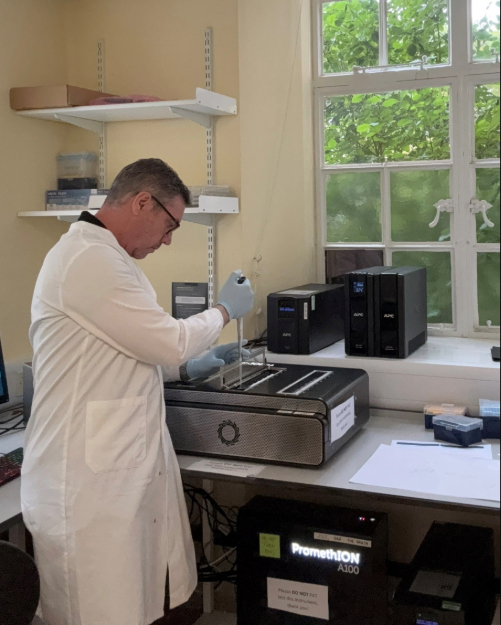
At the beginning of summer, I collected kefir, soil (taken from Trinity Hall Central Site), and cat skin samples from a willing and friendly participant and learned how to clean, organise, and interpret complex raw read outputs using bioinformatics tools for metagenomic analysis. This involved becoming comfortable with the command-line interface, exploring programming languages such as Python and R, and using open-source platforms to align reads, identify species, and draw meaningful conclusions about the microbial communities present in each of our samples.
Our goals were to identify the detailed microbiome composition of both the kefir and soil samples to offer valuable guidance for optimising kefir production and provide insights into gardening practices involving or dependent on these soils. We also aimed to characterise the microbiomes of cats, from their different living environments to age groups, potentially uncovering information relevant to their health and wellbeing.
I quickly learned during my internship that waiting for enormous amounts of data to be processed, such as blastn alignments and genome assembly, was proving inefficient and I had to find a better solution to analysing our samples. This led us to discovering more time-efficient and practical choices like minimap2 and miniasm that fit the traits of large nanopore data specifically.
By mid-August, we had generated detailed microbiome profiles for all but one of our main samples. For kefir, our analysis identified the core bacterial and yeast species that were likely responsible for its fermentation qualities and affirmed that the species found in the product belonged to a brand new (and as yet unnamed) strain! The soil samples analyses revealed the ‘supersoil’ used by the gardeners contained rare microbiome species, which could be the reason underlying their beneficial quality for plant health.
This experience has prepared me for my final year by improving my technical and problem-solving skills. I am now more comfortable in handling bioinformatics work, which will be incredibly useful for my upcoming Part II projects where I hope to still be focusing on bioinformatics. Equally as important, working closely with experienced researchers has improved my ability to collaborate, communicate findings clearly, and adapt quickly when experiments or analyses do not go as planned. The Enright lab has been an incredibly welcoming environment to work in, with its members showing endless patience, intellectual curiosity and a willingness to help and collaborate. Professor Enright has the rare ability to explain complex ideas in a clear and grounded way – while also giving students the space to think independently and make their own discoveries. I feel incredibly lucky to have worked on this summer project and looking ahead, I hope to build on this foundation in the future.
The Undergraduate Summer Research Projects were made possible thanks to our generous donor, alumnus Iain Drayton (1991).