Trinity Hall Logo
Hamburger menu icon
Search button Email us button
  • Menu

  • Back
  • Back
  • Back
  • Study with us
    • Study with us
    • Undergraduate Study
      • Undergraduate Study
      • Courses
      • Entry Requirements
      • How to Apply
      • Fees and Finance
        • Fees and Finance
        • Financial Support
        • Living Costs
        • Tuition Fees
      • Open Days, Events and Visits
      • The Admissions Team
      • Prospectus
      • FAQs
      • Student Profiles
      • Access and Outreach
    • Postgraduate Study
      • Postgraduate Study
      • How to Apply
      • Visiting Postgraduate Students
      • Postgraduate Studentships
      • Studentship FAQs
      • Postgraduate Tutorial Office
      • Contact
    • Life at Trinity Hall
      • Life at Trinity Hall
      • Accommodation
      • Food and Drink
      • Support for Students
    • Access and Outreach
      • Access and Outreach
      • Widening Participation Programmes
      • Teachers and Advisers
      • Parents and Supporters
      • Open Days, Events and Visits
      • The Admissions Team
    • Next Steps
      • Next Steps
      • Trinity Hall Virtual Tour
      • Open Days, Events and Visits
      • Prospectus
      • Student Profiles
    • Why Cambridge?
    • Why Trinity Hall?
  • About Trinity Hall
    • About Trinity Hall
    • The College
      • The College
      • History
      • Masters of Trinity Hall
      • Friends of Trinity Hall Society
    • Arts and Music
      • Art
      • Music
        • Music
        • Music Facilities
        • Chapel Choir
        • Music Society
        • Music Awards
        • Professional Music
        • Recordings
    • Library and Archive
      • Library and Archive
      • Jerwood Library
        • Jerwood Library
        • Information For Students
      • Old Library
        • Old Library
        • About the Old Library
        • Visiting the Old Library
        • Supporting the Old Library
      • Archives
    • Facilities
      • Facilities
      • Sport
      • Gardens
      • Chapel and Interfaith Room
      • Library and Archive
    • People
    • Gift Shop
    • College Governance
    • Student Hub
    • Student Wellbeing
  • Alumni
    • Alumni
    • Alumni News
      • Alumni News
      • Obituaries
    • Publications
      • Publications
      • Front Court
      • Trinity Hall Review
      • Working TogeTHer
    • Alumni Benefits
      • Alumni Benefits
      • Accommodation and Events
      • Dining Privileges
    • Alumni Events
      • Alumni Events
      • College Reunions
      • The Cambridge MA Degree
      • Graduation
      • Alumni Events FAQs
    • Alumni Networks
      • Alumni Networks
      • Careers Network
      • Trinity Hall Entrepreneurs Network (THEN)
        • Trinity Hall Entrepreneurs Network (THEN)
        • Case Studies
        • Reports
        • Entrepreneurship Funds and Awards
        • Cambridge Social Innovation Prize
      • Trinity Hall Association
        • Trinity Hall Association
        • THA Volunteering Awards
        • THA Committee
      • Aula Club
      • Trinity Hall Boat Club
    • Trinity Hall Reps
    • Contact the Alumni & Development Team
    • Keep in Touch
    • Gift Shop
  • Supporters
    • Supporters
    • Anniversary Campaign
      • Anniversary Campaign
      • Find Your Cause
      • Your Impact
      • About the Campaign
    • How to Give
    • Get Involved
      • Get Involved
      • Trinity Hall Reps
      • THA Committee
      • Development Committee
  • Conferences and Events
  • News and Events
    • News
    • Events
    • Editor’s Choice
  • Contact Us
    • Contact Us
    • Fellows and Academics Directory
    • Staff Contact Directory
  • Intranet
  • Vacancies
    • Vacancies
    • Postdoctoral Research Associateships
    • Staff Vacancies
    • Academic Vacancies
Home > News > From Cambridge to San Diego: Crossing Cold War boundaries in the Chinese Collections

From Cambridge to San Diego: Crossing Cold War boundaries in the Chinese Collections

Posted:
19 Jun 2026
Written by:
Ian Dubrowsky

Ian Dubrowsky travelled from University of California San Diego, to spend five weeks researching the Chinese Collections at Cambridge University Library. From uncovering global networks hidden within industrial records to finding a working community among the stacks, Ian reflects on his time as the 2026 WongAvery Visiting Scholar.

When I arrived at Cambridge University Library in March for five weeks as the 2026 WongAvery Visiting Scholar, I thought I was coming to sharpen a national history. Five weeks at Cambridge turned that story into a global one.

My dissertation examines the Daqing Oilfield, the flagship industrial project of Maoist China, discovered in 1959 and mythologised as proof that the country could build a modern economy on its own terms. It also examines the 1960 Laobaidong coal mine disaster, which killed more than six hundred workers and was buried from the historical record for nearly three decades.

I had spent years tracing how one industrial site became a site of national celebration while another became a site of official silence, and I understood the project as a story about China: its workers, its state, and its habits of memory and forgetting.

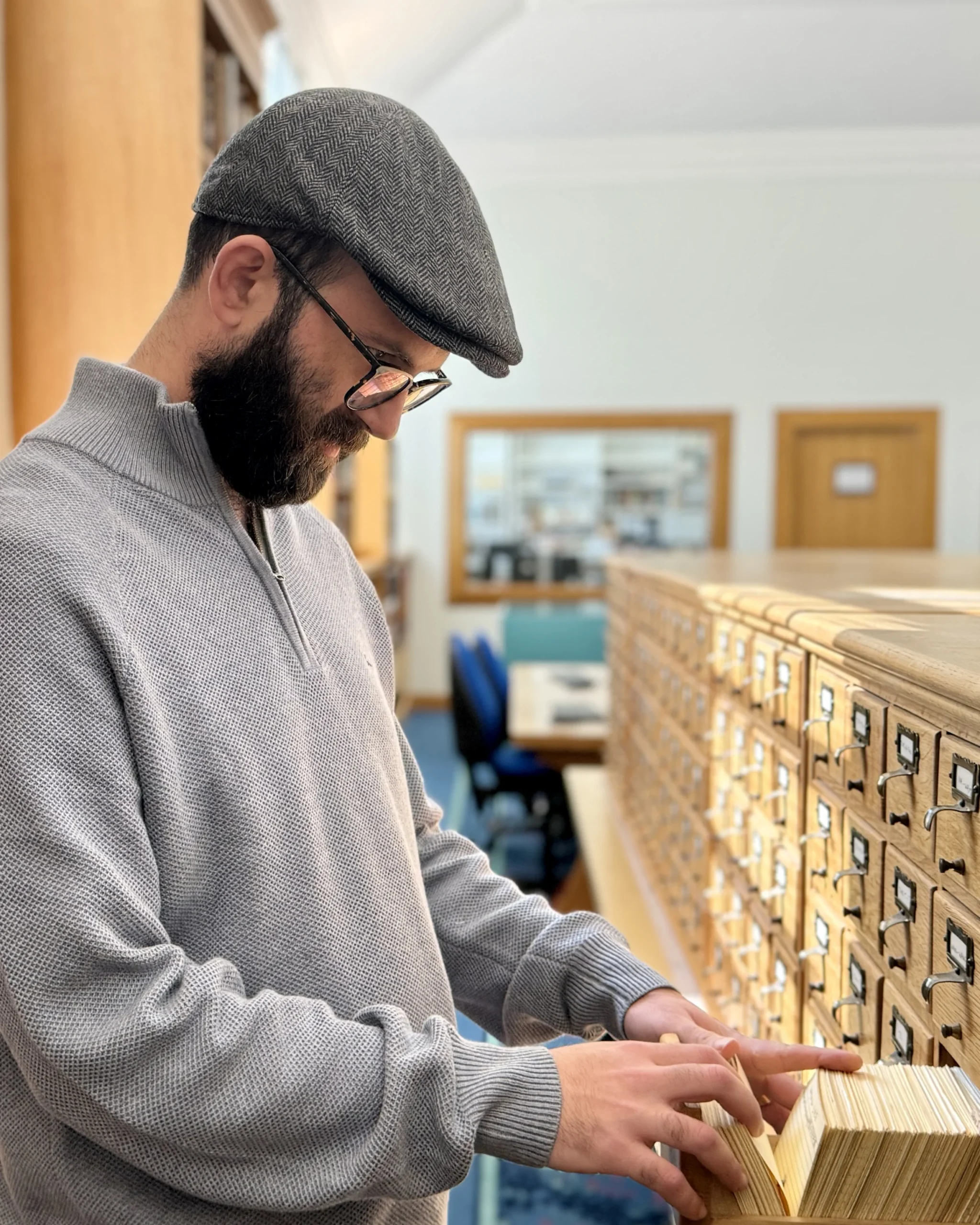
Ian Dubrowsky sitting at a desk browsing the Chinese Collection in the University Library.

“I’m interested in the factory floor, the mines, the oilfields, the steelworks. I’m interested in understanding these industrial spaces as social and politically constructed zones.

Instances of death, injury, and disaster provide a window into Chinese industrial governance through the present.”

The Chinese collections at Cambridge University Library hold a remarkable range of bibliographic catalogues documenting Cold War-era technical and industrial material. Read carefully, these sources reveal not only what Chinese engineers and cadres were doing, but what they were reading, citing, translating, and arguing with. What I had approached as domestic sources turned out to be documents in conversation with the world.

Seen from Cambridge, Chinese industry in the Mao era was embedded in circuits of technical knowledge that crossed the Sino-Soviet split, the Cold War blocs, and the supposed isolation of the 1960s and 1970s in ways that standard periodisations obscure.

Information flowed. Expertise travelled. The oilfield I had been studying as a Chinese place was, in its very construction, a node in a much larger network. 

The archival record at Cambridge, combined with the British state’s own mid-century reporting on Chinese industry held at the National Archives at Kew, made that network legible in a way it simply had not been from San Diego.

This is the kind of shift that only happens in certain archives. It required sitting in a reading room for weeks, working through materials not catalogued as “global” or “transnational” but which reveal themselves as such when read side by side.

It required having a librarian who could point me toward what I did not yet know I needed. In Dr Yan He, Head of the Chinese Section at Cambridge University Library, I had exactly that. Her knowledge of the collections is matched only by her generosity in sharing it, and conversations with her over the course of the residency reshaped my sense of what the archive could do.

The Needham Research Institute, where John Moffett hosted me with extraordinary warmth and care, opened further dimensions of the same story: the scientific and technical channels through which Chinese industrial knowledge circulated internationally in a period when it was not supposed to be circulating at all.

The Churchill Archives and the National Archives at Kew rounded out the picture from the other side, allowing me to read British observations of Chinese industry against the Chinese record itself—two vantage points that sometimes agreed, sometimes diverged sharply, and were always productive to hold together.
The dissertation I will write in the coming year is a stronger project because of the five weeks I spent here. It remains centred on Daqing and Laobaidong, and on labour, disaster, and memory in Mao-era China. But it argues, with evidence it did not previously have, that the history of Chinese industry cannot be told as a purely national history.

The flows of information, expertise, and comparison that shaped what happened in the oilfields and mines ran through archives on three continents, and writing honestly about Chinese industrial modernity means following those flows wherever they lead.

Cambridge gave me the sources that made that argument possible, and the colleagues who helped me see them for what they were.

The scholarly community I encountered here is the part of the residency I will carry with me the longest.

I came expecting to find sources. I found a working community—one whose generosity is not, I think, fully captured by anything I will write in a footnote, and which I hope to remain part of for a long time.

The WongAvery Scholar Exchange placed me in sustained conversation with historians, social scientists, and librarians across Cambridge whose questions and criticisms improved the project at every turn. The Library’s staff made the archives feel navigable rather than overwhelming. The programme’s coordinators and the University Library Research Institute met every logistical question with patience and care.

The archive of modern Chinese industry is scattered across the world, and the work of assembling it is necessarily collective. Five weeks ago I understood that abstractly. I understand it now as a practice, and as a gift.

The WongAvery Visiting Scholar Exchange Programme is generously supported by the Avery-Tsui Foundation, in collaboration with Cambridge University Library, UC San Diego Library and Trinity Hall, Cambridge.

Original story by Cambridge University Library. Photos by Lizzie Woodman / Cambridge University Library.

Back to all news
  • Follow us
  • Facebook logo
  • Twitter logo
  • Instagram logo
  • LinkedIn logo
  • YouTube logo
  • Linkhall logo
  • Bluesky logo
Trinity Hall Logo

Trinity Hall, Cambridge, CB2 1TJ
Maps and Directions

  • t: +44 1223 332500
  • e: info@trinhall.cam.ac.uk
University of Cambridge logo

Quick links

Study with us

  • Study with us
  • Courses
  • Postgraduate Study
  • The College
  • Accommodation
  • Support for Students

The College

  • People
  • Vacancies
  • Library and Archive
  • Gift Shop
  • College Governance
  • Data Protection and Freedom of Information

Alumni

  • Alumni Events
  • Alumni Benefits
  • Dining Privileges

Supporters

  • Your Impact
  • Recognition

Conferences

  • Conferences
  • Events
  • Dining
  • Weddings
  • Accommodation

© 2026 Trinity Hall Cambridge All Rights Reserved. Trinity Hall is a Registered Charity, number 1137458

Web design by Crucible
  • Website Policy
Manage Consent
To provide the best experiences, we use technologies like cookies to store and/or access device information. Consenting to these technologies will allow us to process data such as browsing behaviour or unique IDs on this site. Not consenting or withdrawing consent, may adversely affect certain features and functions.
Functional Always active
The technical storage or access is strictly necessary for the legitimate purpose of enabling the use of a specific service explicitly requested by the subscriber or user, or for the sole purpose of carrying out the transmission of a communication over an electronic communications network.
Preferences
The technical storage or access is necessary for the legitimate purpose of storing preferences that are not requested by the subscriber or user.
Statistics
The technical storage or access that is used exclusively for statistical purposes. The technical storage or access that is used exclusively for anonymous statistical purposes. Without a subpoena, voluntary compliance on the part of your Internet Service Provider, or additional records from a third party, information stored or retrieved for this purpose alone cannot usually be used to identify you.
Marketing
The technical storage or access is required to create user profiles to send advertising, or to track the user on a website or across several websites for similar marketing purposes.
  • Manage options
  • Manage services
  • Manage {vendor_count} vendors
  • Read more about these purposes
View preferences
  • {title}
  • {title}
  • {title}