Volunteering in Peru
The following report was written by Alex Barker.
I spent the long vacation of 2025 in Peru volunteering with a couple of projects in the Cusco area. The experience was both challenging and eye-opening, and I believe it will have had far-reaching effects on my ability to serve the world around me.
Building a school with Un Mundo Mejor Para los Ninos Andinos (A Better World for the Andean Children)
The first two weeks were spent working on a project to build a school in a suburb of Cusco called Puerto Rico. This area really solidified my understanding of Cusco as a developing city, whilst the historic centre of Cusco was rather wealthy due to a large presence of the city’s tourist attractions, this suburb of approximately 500 families only had 4 working professionals among them and the area reflected this. The school project was very important to the residents of Puerto Rico as it gave their children an opportunity to enter into professional careers themselves. They learnt maths, Spanish and English there in the afternoons even though the school wasn’t finished. While I was there, we worked on putting up doors for the 4 different rooms, painting the doors and windows as well as building an outdoor sink.
The working day would start at 8am which was made more challenging by the Andean climate, since Cusco was 3,400m above sea level, the temperature depended solely on the Sun. The temperature dropped steadily during the night so it was coldest in the morning, often below 0°C, but would rise sharply in the day to roughly 21°C, this made the mornings working at the site very cold but the later hours quite hot and draining. We would work for about 4 hours which initially didn’t feel like much and I was keen to do more; but, as the days went by the work became more physically demanding and I was grateful for the morning shifts.
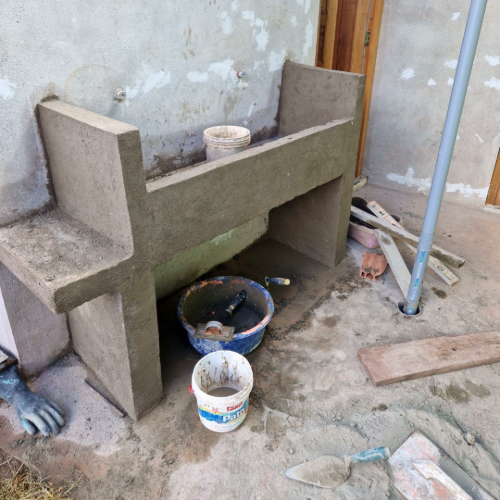
The most significant job I did while I was there was to build the outdoor sink (pictured). When I arrived it took the form of two towers of bricks held by concrete and when I left the sink had taken its proper shape and only needed to be tiled. I learned a lot about concrete, construction and the creativity of Peruvian builders. It was very important the get the job done with the tools available which meant repairing drills and mixing concrete by hand. As an engineer, it made me consider what career path I wanted to take as well as how much I take for granted when it comes to working in my profession. It was inspiring to see the residents of Cusco use the resources they had appropriately and sparingly to build something practical and improve the quality of life in the area.
Working at Azul Wasi (Blue Home)
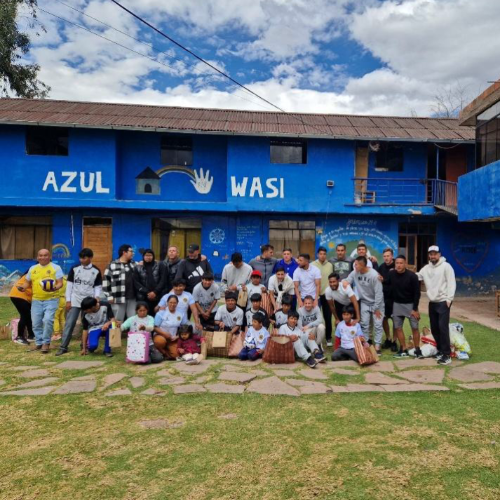
I then travelled an hour’s bus ride outside of Cusco for the second half of my volunteering experience, which was a month’s stay at an orphanage, Azul Wasi. Azul Wasi opened in 2004 for children found on the streets of Cusco and has grown from a small wooden-framed building on stilts to three furnished buildings and a football pitch in the Andean valleys. It was setup by Alcides, who came up with the idea when he was a police officer in Cusco, and is run day-to-day by Dante, a former resident of Azul Wasi, and his wife Vicky. There were roughly twelve children staying there, ten boys and two girls, and Dante’s nieces and nephews stayed from time to time.
The typical day started with a 6am wake up in order to start cooking at 6.30am. This was arguably the hardest part of the day, not least because a year of rowing at Trinity Hall still hasn’t got this student used to early mornings, but also because of the ice-cold temperatures and lack of room insulation. Vicky would already be in the kitchen when myself and any other volunteers (there were usually one or two) made our way down to seek the warmth of the gas stoves before preparing breakfast, packed lunches, soup and lunch (which was also dinner). The orphanage would receive a delivery of fruit and vegetables once every two weeks or so from local farmers and buy some whole chickens from the village nearby. This meant there was significant work to be done in the kitchen in the mornings; it wasn’t uncommon to be washing, peeling and chopping potatoes for two hours.
Once the children had gone to school and the cooking was done, there was down time for a few hours until the younger children returned from school at 2pm. We’d have lunch with them then help with their homework, although they usually didn’t want any. On top of this, my level of Spanish provided a bit of a barrier to this kind of help, I could communicate well enough, but I lacked sufficient detail to communicate fluently and join in with all the activities, all except football! They called me “Amigo Palmer” after Chelsea striker Cole Palmer, that was until they realised, I was an awful football player. It then became “Amigo Palmer malo.” I still did his ice-cold celebration every time I scored and they’d all say “Siempre frio!”. Every school night at 6pm there would be a Bible study which was really enjoyable to be a part of and try to understand what was being said.